Crypto news report · source clearly identified
US regulators approve new class of crypto-focused national trust banks
Circle now has a federal bank charter. However, the charter provides no ordinary checking accounts, FDIC-insured savings accounts, or mortgages. Circle National Trust is part of a new federal cohort built around custody, fiduciary administration, stablecoin reserves, and settlement.
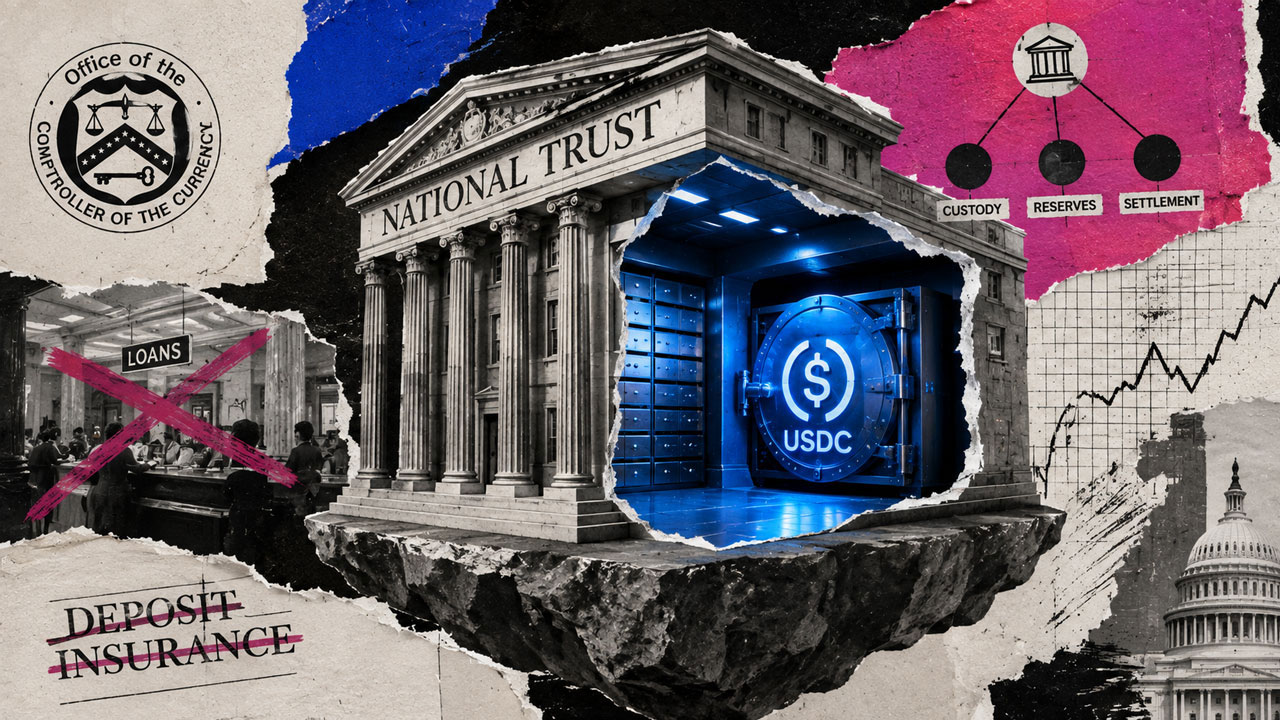
The Office of the Comptroller of the Currency (OCC) has begun granting national trust charters to a growing group of crypto‑related firms. Unlike traditional commercial banks, these entities are limited to fiduciary services such as custody, reserve management and settlement, without offering checking accounts, FDIC‑insured deposits or mortgage lending.
What a national trust charter means
A national trust bank’s core function is to hold property for others, administer assets and execute instructions. The OCC’s guidance notes that most trust banks do not accept deposits, make loans or carry FDIC insurance. This model aligns with the needs of digital‑asset issuers, custodians and settlement platforms, which require regulated oversight of private‑key security, segregation of customer assets and stablecoin reserve custody.
Companies receiving OCC approval
- Circle – final approval for First National Digital Currency Bank (Circle National Trust) on July 10, 2026, with initial fiduciary custody for Circle and affiliates.
- Ripple – preliminary conditional approval for Ripple National Trust Bank (Dec. 12, 2025).
- BitGo, Fidelity Digital Assets, Paxos – conditional conversion approvals (Dec. 12, 2025) to operate as national trust banks.
- Bridge – preliminary conditional approval (Feb. 12, 2026) for stablecoin issuance and reserve management.
- Foris DAX, Crypto.com, Coinbase, Morgan Stanley Digital Trust, World Liberty Trust Company – various preliminary or conditional approvals ranging from Feb. 20, 2026 to Aug. 14, 2026.
Regulatory context
Since December, the OCC has approved five digital‑asset applications in a single announcement, signaling a coordinated federal approach. Comptroller Jonathan Gould reported that 23 of 40 de novo charter applications in the past 18 months included digital‑asset activities, and the agency expects to finalize the GENIUS Act rule by November.
Implications for the financial system
The new trust banks separate custody and settlement functions from traditional deposit‑taking and lending activities. While this provides a supervised environment for stablecoin reserves and tokenized assets, it also means that the credit‑creation role of banks—supporting mortgages and small‑business loans—remains with conventional commercial banks. Critics note that large‑scale migration of deposits into tokenized forms could reduce low‑cost funding for lenders.
Key takeaways
- The OCC is creating a federal category for crypto‑focused national trust banks.
- These institutions do not offer typical banking products such as checking accounts or FDIC‑insured deposits.
- Regulated custody, reserve management and settlement are the primary services authorized.
- Several major crypto firms have received either final or conditional approvals.
- The model aims to bring institutional crypto activities under a single supervisory umbrella while leaving deposit‑taking and lending to traditional banks.
Source & attribution
News Source
- Publisher
- CryptoSlate
- Original date
- August 23, 2026, 9:00 AM
- Original headline
- America is creating a new class of crypto banks – but they aren’t really banks