Crypto news report · source clearly identified
Standard Chartered projects SKY token to reach $0.325 by 2028
Standard Chartered expects SKY to climb from a reference price of $0.065 to $0.325 by end-2028, tying its fivefold projection to expanding USDS supply, agent borrowing, staking rewards, and token buybacks.
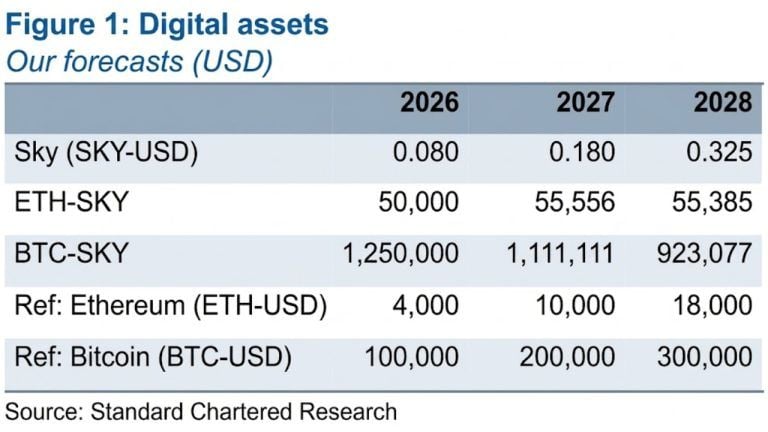
Standard Chartered’s digital‑asset research team has set a five‑year price target of $0.325 for the SKY governance token, representing a five‑fold increase from its current reference level of $0.065. The projection was disclosed in a research note dated September 11, 2026.
Key drivers behind the forecast
The bank links the anticipated price rise to several ecosystem developments:
- Continued expansion of USDS, the dollar‑pegged stablecoin that supplies liquidity to the Sky protocol.
- Growth in agent borrowing activity, which has already reached $5.9 billion since the model’s launch in September 2024.
- Increased distribution of staking rewards funded by treasury‑backed token buybacks.
- Additional revenue channels such as the stUSDS product, which enables borrowing against staked SKY.
Revenue model and token mechanics
Sky agents act as decentralized capital allocators, borrowing USDS at wholesale rates and deploying it across approved yield strategies. The protocol funds staking rewards through open‑market repurchases of SKY, which can be burned or redistributed to stakers. The maximum supply is capped at 23.46 billion SKY.
Comparative outlook
Standard Chartered’s note suggests SKY price gains will track closely with Ethereum (ETH) and outperform Bitcoin (BTC) through the end of 2028. The bank’s separate 2028 targets are $18,000 for ETH and $300,000 for BTC.
Risks
The primary risk identified is slower‑than‑expected growth in yield‑bearing stablecoins, which could limit USDS expansion and, consequently, protocol revenue.
Source & attribution
News Source
- Publisher
- Bitcoin.com News
- Original date
- September 13, 2026, 3:05 AM
- Original headline
- Analyst Sees SKY Rising 5x, Beating Bitcoin on ‘Federal Bank’ Model