Crypto news report · source clearly identified
Banks Develop Tokenized Deposits to Replicate Stablecoin Benefits Without Losing Funding
Banks argue that tokenized deposits let them offer programmable, 24/7 settlement while keeping money on their balance sheets, preserving cheap funding that stablecoins could otherwise draw away.
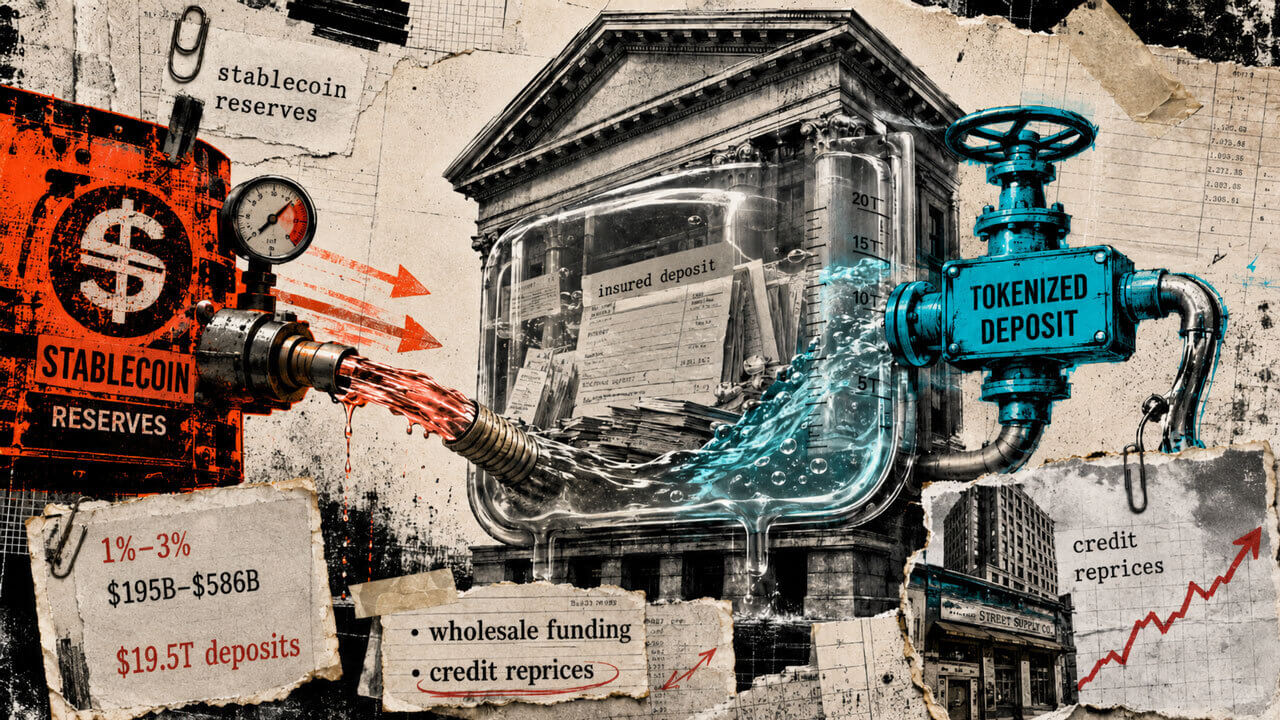
Banking institutions are promoting tokenized deposits as a way to provide the same programmable, round‑the‑clock settlement features of stablecoins while retaining the underlying funds on their balance sheets. Falcon Finance’s chief RWA officer Artem Tolkachev explained that the distinction lies in who holds the risk, not in the technology itself.
How tokenized deposits differ from stablecoins
A tokenized deposit remains a traditional bank deposit that has been digitized. The $100 million stays on the issuing bank’s balance sheet, allowing the bank to lend against it and keeping the deposit insured. In contrast, a reserve‑backed stablecoin moves the money into the issuer’s reserve assets, exposing holders to the issuer’s operational and reserve risk without deposit insurance. An over‑collateralized synthetic dollar is backed by collateral held separately from the issuer, with risk tied to the collateral strategy and custody arrangements.
Funding implications for banks
If stablecoins draw deposits away, banks lose cheap, sticky funding and must replace it with more expensive wholesale financing. This raises funding costs, compresses net interest margins, and can lead to tighter lending standards. Tokenized deposits aim to prevent this outflow by offering a programmable alternative that keeps deposits within the banking system.
Regulatory perspective
The Dallas Fed notes that a deposit token remains a commercial‑bank deposit subject to the same supervisory framework. The FDIC has indicated that deposits held as stablecoin reserves would be insured to the issuer as a corporate deposit, but individual stablecoin holders would not receive direct insurance coverage.
Industry moves
Wells Fargo plans to launch tokenized deposits for corporate clients, starting with USD‑to‑GBP transactions and expanding through 2027. JPMorgan already operates JPM Coin, a deposit token on the Base blockchain, where the underlying balance stays on the bank’s books.
Potential outcomes
In a bullish scenario, large banks create interoperable tokenized‑deposit networks that keep corporate treasury balances on‑bank while offering 24/7 programmable settlement. In a bearish scenario, even a modest shift of 1‑3 % of U.S. commercial‑bank deposits to stablecoins could raise funding costs and pressure loan pricing.
Source & attribution
News Source
- Publisher
- CryptoSlate
- Original date
- August 26, 2026, 4:40 PM
- Original headline
- Banks found a way to copy stablecoins without losing the money that funds their loans