Crypto news report · source clearly identified
BIS paper shows institutional use of XRP Ledger won’t create a supply squeeze for XRP
A Bank for International Settlements working paper demonstrates a prototype that anchors statistical data on the XRP Ledger using Merkle batching, keeping fee‑burn impact minimal even as usage scales.
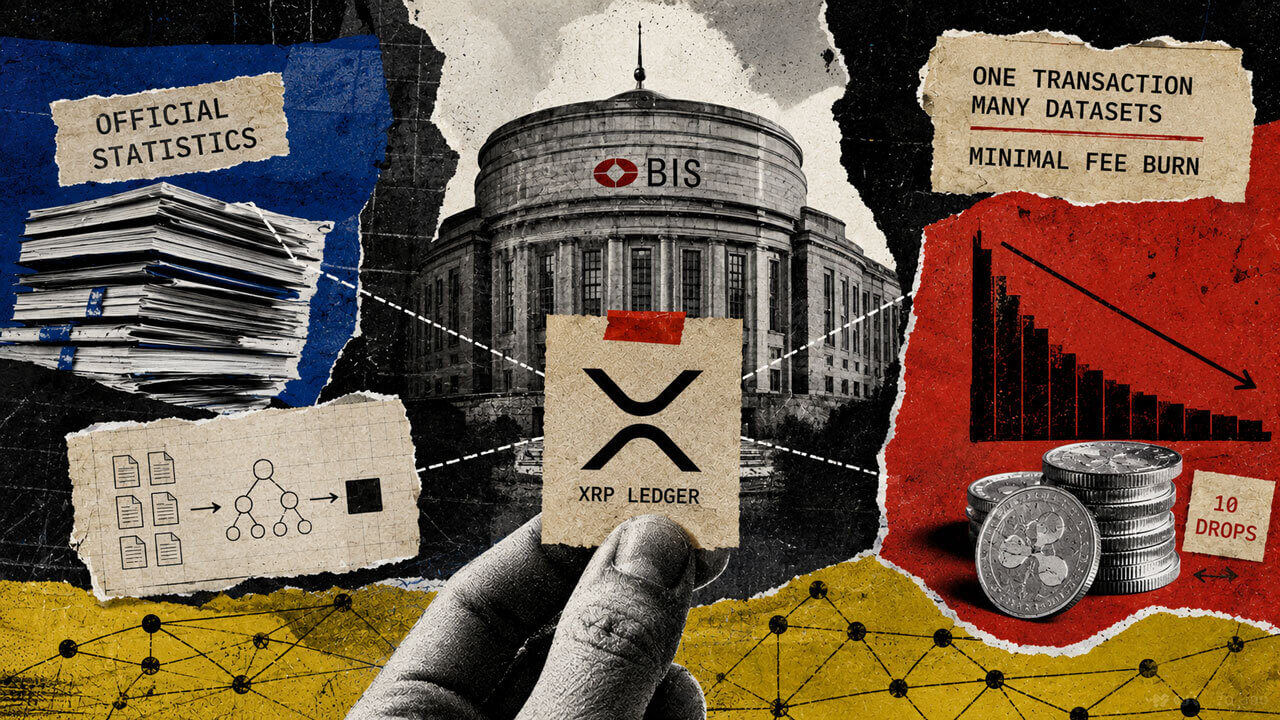
A Bank for International Settlements (BIS) working paper released on September 2 describes a prototype that uses the XRP Ledger (XRPL) as a public notary for authenticating official statistics. The system hashes statistical files, aggregates the hashes in a Merkle tree, and writes the tree root into the memo field of a single XRPL transaction.
How the prototype works
Statistical data in the SDMX format is normalized and hashed with SHA3‑512. Individual hashes are combined into a Merkle tree, whose root is anchored on XRPL. The original file carries the transaction reference and a signed verifiable credential, allowing recipients to reconstruct the root and verify it against the ledger entry. The ledger therefore provides a timestamped commitment without storing the data itself.
Batching keeps fee burn low
One XRPL transaction can represent thousands of datasets. With the standard fee of 10 drops (0.00001 XRP) per transaction, the paper illustrates that anchoring 1 million datasets in batches of 1,000 would burn only 0.01 XRP, whereas anchoring each dataset individually would burn 10 XRP. Even anchoring once per second for a full year would burn about 315 XRP, showing that fee‑burn scales with transaction count, not data volume.
Reserve requirements and token demand
XRPL’s reserve model requires each address to hold a base reserve of 1 XRP plus 0.2 XRP for each ledger object. Anchoring multiple datasets from an existing account does not increase the reserve requirement, so token demand would arise mainly from creating new accounts or additional ledger objects, not from dataset throughput.
Implications for XRP holders
The prototype is experimental, runs on XRPL DevNet with test XRP, and does not generate real‑world token demand. The BIS analysis concludes that, under current fee mechanics and assuming Merkle batching, institutional adoption of this authentication use case is unlikely to create a significant supply squeeze for XRP. Market price could still be influenced by broader network activity and expectations, but the specific anchoring workflow described does not provide a strong direct burn pathway.
Source & attribution
News Source
- Publisher
- CryptoSlate
- Original date
- September 3, 2026, 8:00 PM
- Original headline
- BIS shows why real institutional adoption on XRP Ledger won’t trigger the XRP supply squeeze holders expect