Crypto news report · source clearly identified
BlackRock predicts AI‑driven demand could add trillions to stablecoin transaction volume
BlackRock’s new report warns that autonomous AI agents could become a major source of stablecoin payments, potentially generating $5 trillion of spend on computing resources by 2030.
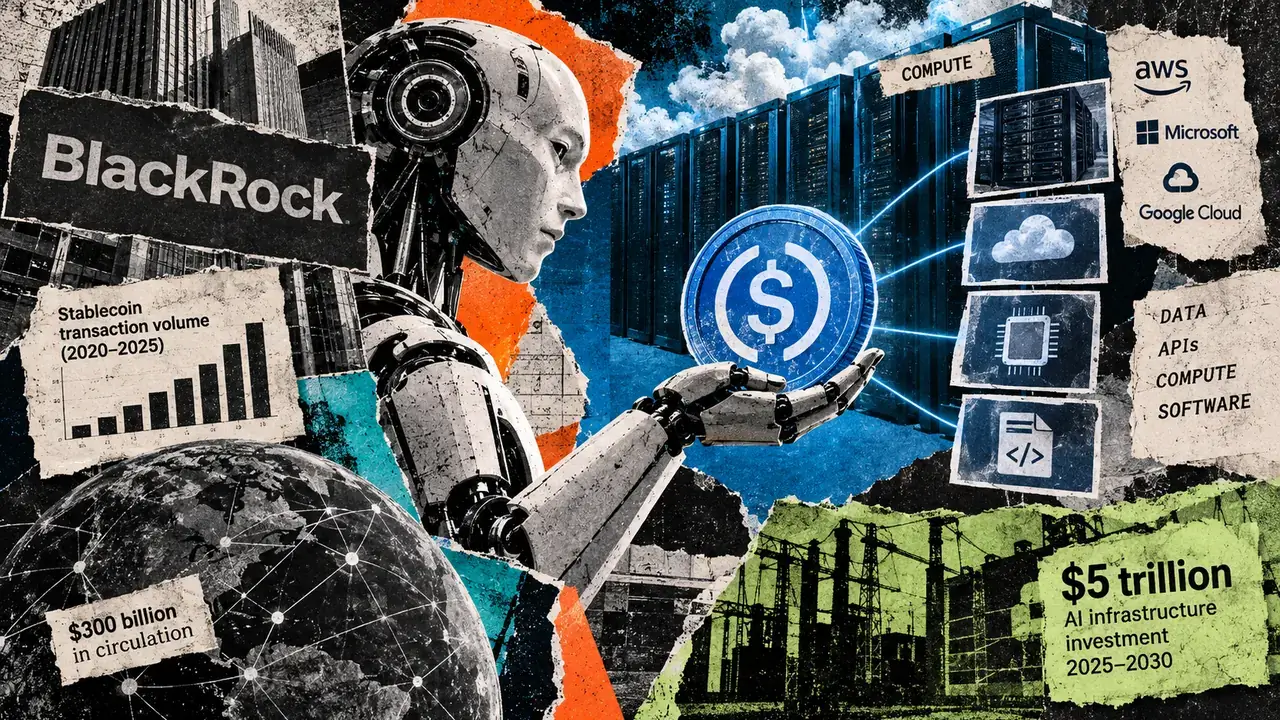
BlackRock’s latest research paper, *The Machine‑Native Economy*, highlights a emerging use case for stablecoins: continuous, machine‑to‑machine payments without human approval. As AI systems become more autonomous, they could repeatedly purchase data, API calls, and computing power, creating a new class of stablecoin customer.
Scale of the opportunity
BlackRock estimates stablecoins will handle about $11.2 trillion of adjusted transaction volume in 2025, growing at an 80 % compound annual rate since 2020. The firm projects AI‑related spend on infrastructure could exceed $5 trillion between 2025 and 2030, driven by cloud providers such as AWS, Microsoft Azure, and Google Cloud.
How machine payments differ
Unlike traditional card or ACH transactions, AI agents would execute thousands of sub‑cent payments around the clock for tasks like API access or compute cycles. These micro‑transactions suit programmable wallets that can settle automatically, giving stablecoins a potential advantage over legacy rails.
Competing payment protocols
Several initiatives aim to standardise machine payments:
- Coinbase’s x402 protocol uses HTTP 402 to request payment before delivering data.
- Stripe and Tempo are developing a Machine Payments Protocol that can settle via stablecoins or conventional methods.
- Stripe‑OpenAI’s Agentic Commerce Protocol and separate standards from Google and Visa address agent identity and authorisation.
These efforts suggest that machine commerce may not automatically migrate to blockchain networks.
Implications for blockchain ecosystems
Higher stablecoin throughput could increase demand for blockspace and validator services on networks such as Ethereum, but the capture of economic value depends on fee structures, staking economics and gas‑sponsorship models. Some platforms, like Circle’s Arc, use USDC as the native gas asset, allowing stablecoin activity to boost the token without directly benefiting a separate native asset.
Outlook for investors
Stablecoin issuers stand to gain transaction volume, while the underlying blockchains must ensure that increased usage translates into token demand. Traditional payment networks also aim to retain machine‑driven spend on existing rails, creating a competitive landscape for the “machine wallet.”
Source & attribution
News Source
- Publisher
- CryptoSlate
- Original date
- September 23, 2026, 8:50 PM
- Original headline
- BlackRock sees a new $5 trillion AI trade emerging for stablecoins