Crypto news report · source clearly identified
Coldcard firmware update adds mandatory physical entropy after seed generation flaw
Coldcard’s new firmware (v5.6.1 for Mk4/Mk5, v1.5.1Q for Q devices) now requires at least 65 random key presses, 50 dice rolls, or 128 coin flips when creating a seed, but existing seeds from vulnerable versions must be replaced.
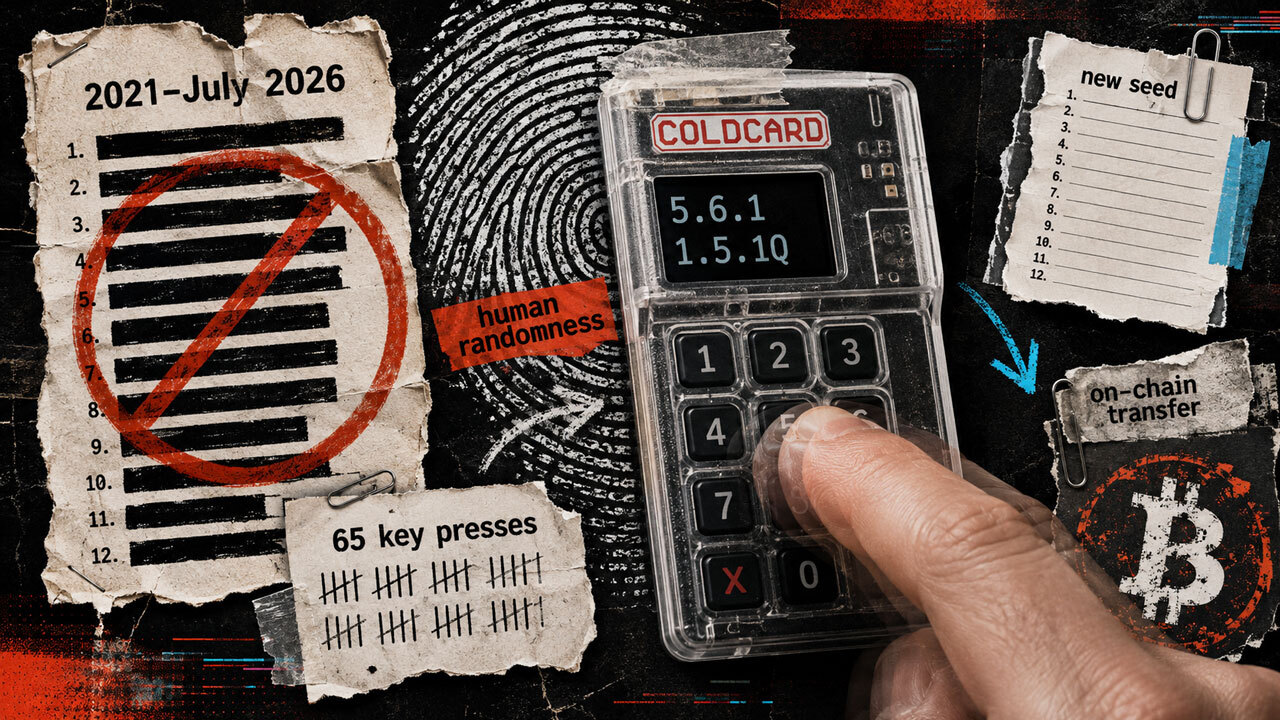
Coinkite has released updated firmware for its Coldcard Bitcoin hardware wallet that forces users to add physical randomness during seed creation. The change addresses a previously disclosed flaw that could allow attackers to reconstruct private keys.
What the new firmware does
When generating a new seed, the wallet now requires one of the following sources of entropy:
- At least 65 unpredictable key presses
- 50 rolls of a six‑sided die
- 128 physical coin flips
This requirement supplements the device’s internal random‑number generator and reduces reliance on it alone.
Versions and migration guidance
Coldcard recommends installing version 5.6.1 for Mk4 and Mk5 devices and version 1.5.1Q for Q devices. Users who generated a seed with earlier firmware (Mk2/Mk3 firmware 4.0.1‑4.1.9, Mk4/Mk5 standard firmware before 5.6.0, Edge firmware before 6.6.0X, Q standard firmware before 1.5.0Q, Edge firmware before 6.6.0QX) must create a new seed and move any funds, unless they meet the “dice‑roll exception.”
Dice‑roll exception
If a user generated a seed using at least 50 independent die rolls and never recorded the sequence, the existing seed is considered safe and migration is not required. Users uncertain about the number or privacy of their rolls should treat the seed as vulnerable.
Technical details of the flaw
The vulnerability stemmed from code that could fall back to a deterministic MicroPython RNG when a feature flag was incorrectly interpreted as enabled. Adding mandatory human‑generated entropy prevents exploitation of this fallback in future seed generations, but it cannot retroactively secure seeds already created.
Additional firmware hardening
The update also introduces several security enhancements, including:
- USB transaction review with staged PSBT checksum verification
- Blocking of SIGHASH_SINGLE signing mode by default
- Restrictions on USB firmware downloads to the current encrypted session
- Boot‑time hardware RNG linkage checks and persistent RNG‑fault stops
- Improved isolation for Delta Mode and active‑wallet backup behavior
Impact and next steps
Coinkite reports that some customers have suffered losses, and law enforcement is investigating. However, the company has not released a verified count of affected users or total losses. Affected users should follow the migration guide: generate a new seed, verify the backup and wallet fingerprint, confirm a receiving address on the device, send a small test transaction, and then transfer the full balance from the old seed.
Source & attribution
News Source
- Publisher
- CryptoSlate
- Original date
- August 23, 2026, 5:00 AM
- Original headline
- Coldcard now requires 65 key presses after seed exploit, while exposed funds still must move