Crypto news report · source clearly identified
ERCOT Batch Zero: A New Scoreboard in AI Power Arms Race
Bitcoin miners have found a new way to flex. In 2021, they competed on mining machine preorders and exahashes promised. In 2024 and 2025, the contest shifted toward HPC contracts: who could sign a major customer and announce the biggest deal. Now the competition reaches further upstream, to the electricity those computing ambitions require.
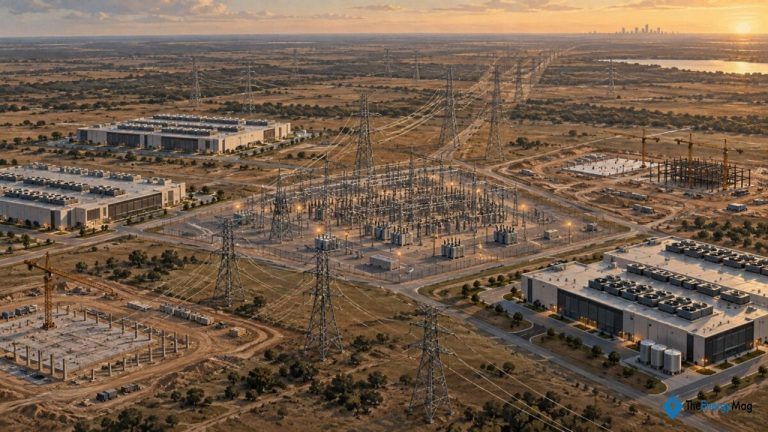
Over the past week, a series of ERCOT Batch Zero announcements have highlighted a growing power‑access competition among crypto‑related compute firms in Texas. Companies are using grid‑classification status as a public indicator of their ability to secure the electricity needed for expanding mining and AI workloads.
Key grid classifications
ERCOT’s Batch Zero process distinguishes between Base Load projects, which retain their position in the study model without further allocation, and Studied Load projects, which must still undergo evaluation and capacity allocation. The distinction matters because Base Load status provides a clearer path to future operation.
Recent company disclosures
- IREN received conditional Base Load status for its 2 GW Sweetwater hub.
- Hut 8 (NASDAQ: HUT) announced a Base Load designation for its Beacon Point project.
- Soluna (NASDAQ: SLNH) secured Base Load for its full 166 MW Kati campus.
- Galaxy disclosed five projects with a total of ~4.2 GW of conditional classifications: 1.63 GW at Helios I & II as Base Load, and 2.6 GW across Caspian, Selene and Helios III as Studied Load. Notably, the 700 MW Caspian project was provisionally classified as Studied Load.
- CleanSpark (NASDAQ: CLSK) reported 585 MW as Base Load and 300 MW as Studied Load.
- Ionic Digital said its transmission provider indicated a provisional Base Load classification for an additional 466 MW at its Ward County campus, bringing the site’s total to 700 MW.
- Cipher announced 3.2 GW of conditional Batch Zero classifications but did not break down the Base Load versus Studied Load components.
Context of the power race
When ERCOT approved Batch Zero in June, it recorded more than 438 GW of large‑load connection requests, about 89 % from data centers. By early August, that figure rose to over 474 GW, roughly 90 % from data centers and exceeding five times Texas’s historic peak demand. These numbers represent proposed connections, not guaranteed capacity.
Batch Zero evaluates facilities of at least 75 MW that have completed prior studies and show development commitment. Projects that fail to qualify must re‑enter a later interconnection process, making Base Load status a valuable advantage.
Implications for miners and AI compute
Historically, miners highlighted machine orders and projected hashrate. Today, grid‑access announcements serve a similar purpose, signaling future revenue potential from AI and high‑performance computing (HPC) workloads. However, investors must differentiate between:
- Capacity already operating.
- Capacity secured as Base Load.
- Requested capacity still awaiting allocation (Studied Load).
- Remaining regulatory and verification steps.
The ultimate test will be how many of the announced megawatts transition into operational facilities and generate compute revenue.
Source & attribution
News Source
- Publisher
- Bitcoin.com News
- Original date
- September 13, 2026, 8:30 AM
- Original headline
- ERCOT Batch Zero: A New Scoreboard in AI Power Arms Race