Crypto news report · source clearly identified
Ethereum’s Quantum‑Resistance Timeline Forces Hard Choices on Upcoming Upgrades
EF Protocol’s priorities make shorter slots and node efficiencies conditional, while a proposal could move mandatory execution proofs one fork later.
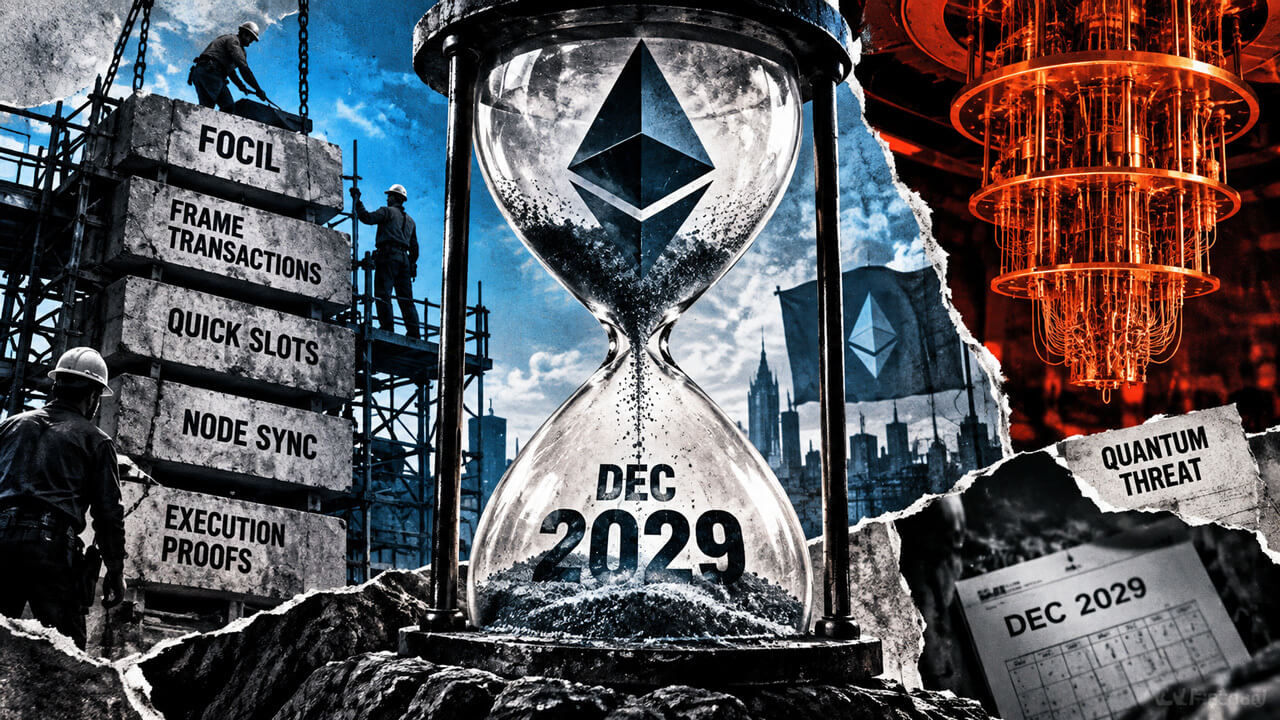
Ethereum developers are tightening the scope of upcoming upgrades as the network races to become quantum‑resistant by December 2029. The Ethereum Foundation’s Protocol cluster has confirmed that the deadline is non‑negotiable at least until a review with external experts in January, putting optional features in direct competition with the work needed to harden the execution, consensus and data layers.
Key upgrades under the microscope
The next upgrade, dubbed Hegotá and scheduled after the Glamsterdam fork, protects two headline features:
- FOCIL – a system designed to strengthen transaction‑inclusion guarantees.
- Frame Transactions – a new account transaction model that adds cryptographic agility, allowing future signature schemes to be adopted without separate hard forks.
The Foundation has stated that its appetite for additional consensus‑layer work beyond FOCIL is “close to zero” unless it directly supports the post‑quantum roadmap.
Potential reshuffling of quantum‑security milestones
Developers are debating whether to move post‑quantum attestations forward from the planned L* fork to the earlier K* fork, while pushing mandatory execution proofs from K* to L*. This shift would accelerate one of Ethereum’s largest quantum‑security changes but could delay the zkEVM timeline.
Scheduling pressure
If Glamsterdam reaches mainnet in December 2026, full post‑quantum readiness is slated for the L* fork, five hard forks later. Achieving the December 2029 target would require an average upgrade cadence of roughly 7.2 months, a pace the Foundation calls aggressive and vulnerable to delays.
A fallback milestone, called MV‑PQ, is planned for the J* fork. It would deliver a minimal post‑quantum consensus heartbeat and limited transaction support, providing a temporary safeguard while full economic finality remains pending.
Prioritisation of proposals
The Protocol cluster evaluated 62 proposals and assigned them to tiers:
- S‑tier: Core fork definitions, protected even if the schedule slips.
- A‑tier: Expected to ship but can be cut before the headliners.
- B‑tier: Must wait for higher‑priority features to stabilise and then compete for remaining capacity.
Examples of B‑tier items include “Quick Slots,” which would shorten Ethereum’s slot time, and a proposal to add ML‑DSA verification pre‑compiles. Both require complete specifications, prototypes and assurance that they will not disrupt the decoupled‑consensus design.
What remains flexible
Not every post‑quantum‑related proposal automatically jumps to the front of the queue. For instance, the Hash‑Chain RANDAO remains B‑tier due to concerns about hardening one part of consensus before the broader quantum‑resistant architecture is settled. Similarly, committing to a specific post‑quantum signature scheme is considered premature while standards evolve.
Frame Transactions, however, stays a protected headliner because its programmable account validation offers cryptographic agility, making it useful regardless of the final signature scheme chosen after Q‑day.
Looking ahead
The next major decision will be whether to shift post‑quantum attestations to K* and move mandatory execution proofs to L*. If the shift occurs, teams working on execution proofs will wait an additional fork, while quantum‑resistant consensus moves forward. If not, developers must sustain a faster upgrade cadence or approach the 2029 deadline with only minimum viable protections, leaving full economic finality unfinished.
Source & attribution
News Source
- Publisher
- CryptoSlate
- Original date
- September 8, 2026, 10:40 AM
- Original headline
- Ethereum’s 2029 quantum deadline is starting to reshape what gets built next