Crypto news report · source clearly identified
Fed Staff Note Highlights Potential Double‑Counting of Stablecoins in U.S. Money Supply
A Federal Reserve staff paper outlines how regulated payment stablecoins could be classified in M1 or M2, but warns that without adjustments for reserve overlap and offshore circulation the same dollars might be counted twice.
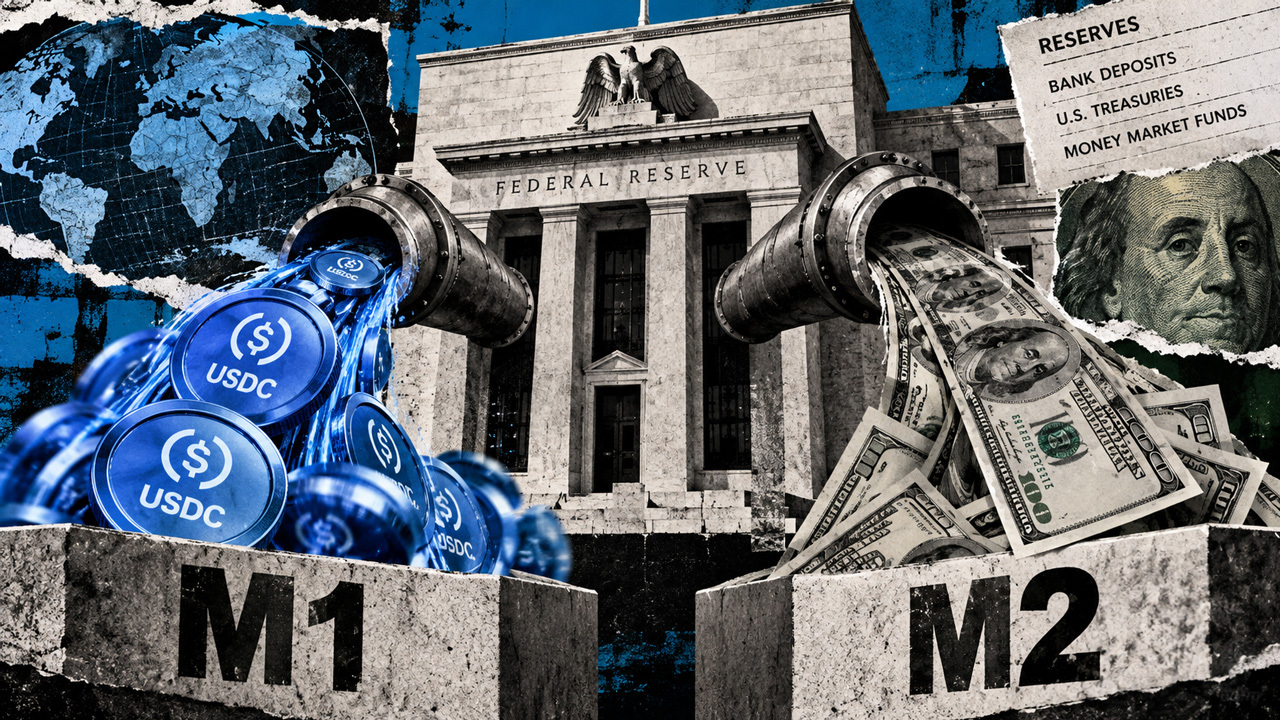
A Federal Reserve staff note released on September 4 sketches a framework for how regulated payment stablecoins could be incorporated into the United States’ monetary aggregates, M1 and M2. The paper stresses that before stablecoins can be added to these measures, adjustments are needed to avoid double‑counting dollars already captured in existing aggregates.
Current exclusion and possible reclassification
At present, payment stablecoins are excluded from official money‑stock statistics. The staff note proposes that classification would depend on the predominant economic use of the tokens. If stablecoins function mainly as a medium of exchange for households and businesses, they could qualify for M1. If they serve more as a store of value or liquidity for crypto trading, they might be placed in the non‑M1 component of M2.
Reserve overlap – the “same‑dollar” problem
Under the GENIUS Act, issuers must hold 1:1 identifiable reserves, which may include bank deposits, Treasury securities, and government money‑market funds. Some of these reserve assets are already counted in M1 or M2. If a stablecoin issuer holds part of the backing in such assets and issues tokens against them, counting the tokens at face value would add a new line to the aggregate while the underlying dollars remain in the existing money‑stock components. The note calls this the “same‑dollar” problem and says the extent of overlap must be quantified before any net addition is calculated.
Geographic considerations
Stablecoins issued by U.S.‑regulated entities can circulate globally on public blockchains. Transaction data often lack sufficient geographic detail to separate U.S. activity from international use. The staff paper notes that additional reporting would be required to isolate the portion of circulation that belongs inside a U.S. money‑stock measure.
Evidence needed for classification
- Functional use: Reliable data on whether tokens are used primarily for transactions (M1) or savings‑type activities (non‑M1 M2).
- Reserve composition: Detailed breakdown of issuer reserves to identify assets already represented in M1 or M2.
- Geographic residency: Information that distinguishes U.S.‑based circulation from global flows.
- Transaction characteristics: Analysis of transfer patterns to determine if they represent standalone payments or complex financial operations.
Illustrative data from USDC
Circle’s July assurance reported 71.826 billion USDC in circulation backed by reserve assets valued at 71.904 billion dollars. The reserve mix includes the Circle Reserve Fund (a government money‑market fund) and Treasury securities held at regulated institutions. While these figures document backing at a point in time, they do not provide a net‑addition estimate for M1 or M2 because the overlap with existing aggregates has not been removed.
Implications for money‑supply measurement
Incorporating stablecoins without addressing reserve overlap and geographic scope could inflate M1 or M2 with dollars already counted elsewhere, offering a misleading signal of new purchasing power. The staff note emphasizes that any reclassification would be a statistical decision separate from current monetary‑policy deliberations, and existing definitions remain unchanged until such adjustments are made.
Source & attribution
News Source
- Publisher
- CryptoSlate
- Original date
- September 5, 2026, 4:45 PM
- Original headline
- Fed stablecoin research exposes how the same dollar could count twice in M1 or M2