Crypto news report · source clearly identified
Final CLARITY Act includes 126 Democrat‑requested changes
Senate Republicans released a final CLARITY Act draft with 126 policy revisions they said Democrats requested during negotiations. The changes alter token classifications, issuer disclosures, exchange rules, DeFi compliance, bank protections, developer safeguards, consumer enforcement, and federal ethics restrictions.
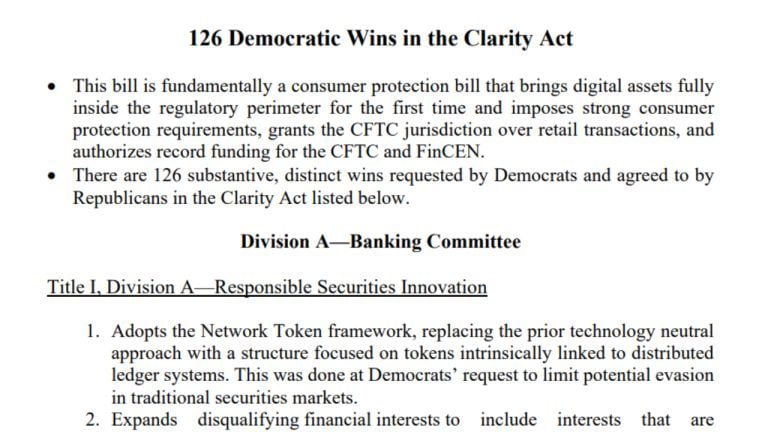
Senate Republicans unveiled a revised draft of the CLARITY Act on September 14, 2026, incorporating 126 policy changes that they attribute to Democratic negotiating requests. The amendments span token classification, issuer disclosure, exchange regulation, decentralized finance (DeFi) compliance, banking safeguards, developer protections, consumer enforcement, and ethics rules for federal officials.
Key areas of revision
Token classification and issuer rules
- Introduces a “Network Token” framework focused on tokens tied to distributed‑ledger systems.
- Requires issuers seeking Regulation Crypto treatment to certify to the SEC that assets are ancillary rather than securities.
- Lowers the annual fundraising limit for Regulation Crypto from $75 million to $50 million, with a $200 million lifetime cap.
- Mandates audited financial statements for issuers raising more than $25 million.
- Adds anti‑evasion and disclosure requirements, including delisting for certain violations.
Illicit‑finance and banking provisions
- Classifies digital‑asset intermediaries as financial institutions under the Bank Secrecy Act, triggering risk‑based examinations.
- Extends federal protections to crypto ATM users.
- Requires DeFi platforms that are not fully decentralized to follow securities and anti‑money‑laundering rules.
- Imposes a 10‑year disqualification for individuals with felony convictions related to financial crime, cybercrime, money laundering, or terrorist financing.
CFTC oversight and exchange rules
- Expands the definition of a digital commodity to include meme coins, network tokens, and ancillary assets.
- Allows CFTC regulation of non‑fungible token (NFT) trading when conducted similarly to commodity transactions.
- Requires exchanges to register as intermediaries, adopt best‑execution and conflict‑of‑interest policies, and provide customer disclosures.
- Mandates custody safeguards, private‑key access testing, and annual certified financial statements.
- Authorizes $150 million in appropriations for CFTC activities and creates a volume‑based fee structure.
Developer safe harbor and ethics rules
- Establishes a civil safe harbor for blockchain developers under the Blockchain Regulatory Certainty Act.
- Restricts elected officials, senior executive‑branch officials, and federal judges from issuing or sponsoring digital assets or holding significant interests in issuers.
- Increases civil monetary penalties, revises financial‑disclosure requirements, and gives state attorneys general enforcement authority.
- Effective one year after enactment, with preservation of certain state consumer‑protection laws.
Legislative outlook
The Senate will hold a cloture vote on September 15 to determine whether debate on the measure can proceed. Cloture requires 60 votes, meaning Republican leaders will need Democratic support to move the bill forward. The vote will not decide final passage but will test the bipartisan viability of the revised CLARITY Act.
Source & attribution
News Source
- Publisher
- Bitcoin.com News
- Original date
- September 14, 2026, 6:17 PM
- Original headline
- Final CLARITY Act Packs 126 Changes Requested by Senate Democrats