Crypto news report · source clearly identified
US Treasury’s $739 Billion Summer Borrowing May Soak Up Crypto Liquidity Before Buybacks Reach Bitcoin
The Treasury plans to issue $739 B of new debt from July to September while also running buyback programs that retire older bonds. The simultaneous issuance and repurchase could affect dollar availability and, indirectly, Bitcoin market conditions.
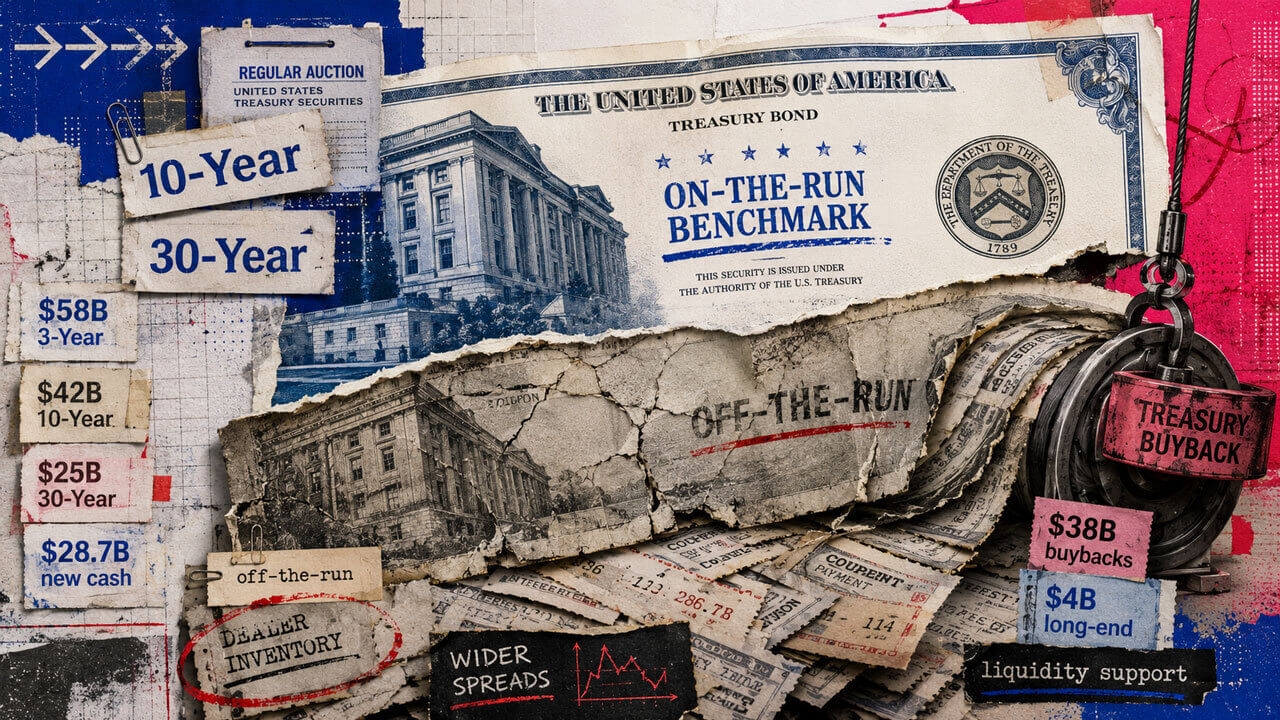
The U.S. Treasury announced a borrowing plan of $739 billion for the July‑September quarter, alongside a series of buyback operations aimed at retiring older Treasury securities.
Borrowing and Refund Schedule
For the August‑September period the Treasury estimates a cash balance of about $950 billion at the end of September and projects an additional $628 billion of borrowing for October‑December. The August refunding included a $58 billion three‑year note, a $42 billion 10‑year note and a $25 billion 30‑year bond, generating roughly $28.7 billion of new cash after accounting for maturing securities.
Buyback Program Expansion
On August 19 the Treasury raised the maximum size of each buyback in the 10‑to‑20‑year and 20‑to‑30‑year buckets from $2 billion to at least $4 billion for operations running from September 9 through November 4. The program authorizes up to $38 billion of liquidity‑support purchases and $25 billion of short‑dated cash‑management purchases for the quarter, though the later expansion means the $38 billion figure is not a hard ceiling.
How Auctions and Buybacks Differ
Auctioned securities create liquid benchmarks that investors use for hedging and price discovery. Buybacks, by contrast, retire selected off‑the‑run issues, giving dealers a regular outlet for older bonds and freeing capacity in the market. The Treasury conducts buybacks through competitive offers on FedTrade, with the New York Fed acting as fiscal agent.
Impact on Dollar Liquidity and Crypto Markets
Each dollar repurchased must be financed elsewhere; for example, selling $100 billion of new securities while buying back $4 billion adds $96 billion of privately held debt. The Treasury’s cash flows move through the Treasury General Account (TGA), affecting reserve balances in the banking system. A $4 billion buyback can place cash in sellers’ hands on settlement day, while a larger auction pulls cash toward the TGA on a different day.
These cash movements influence the availability of dollars, long‑term yields, and dealer capacity—factors that can affect Bitcoin’s financing costs and market dynamics. A well‑received long‑bond buyback may ease liquidity pressure in the Treasury market, potentially improving conditions for Bitcoin, whereas a heavy auction week could absorb cash and tighten dollar availability.
Looking Ahead
The next set of long‑end buybacks begins on September 9, with the next quarterly refunding announcement scheduled for November 4. The actual effect on crypto liquidity will depend on the size of purchases, pricing, demand for new benchmarks, and the Treasury’s cash balance trajectory.
Source & attribution
News Source
- Publisher
- CryptoSlate
- Original date
- August 30, 2026, 10:50 AM
- Original headline
- How $739B in new US debt could absorb crypto’s liquidity before buybacks even reach Bitcoin