Crypto news report · source clearly identified
Small BTC Transfer Highlights Limits of Trump’s “Never‑Sell” Strategic Bitcoin Reserve
A US‑government‑tagged wallet moved about 1.38 BTC from the Alameda Research seizure, prompting questions about which confiscated coins are locked in the Strategic Bitcoin Reserve and which remain subject to restitution or other exceptions.
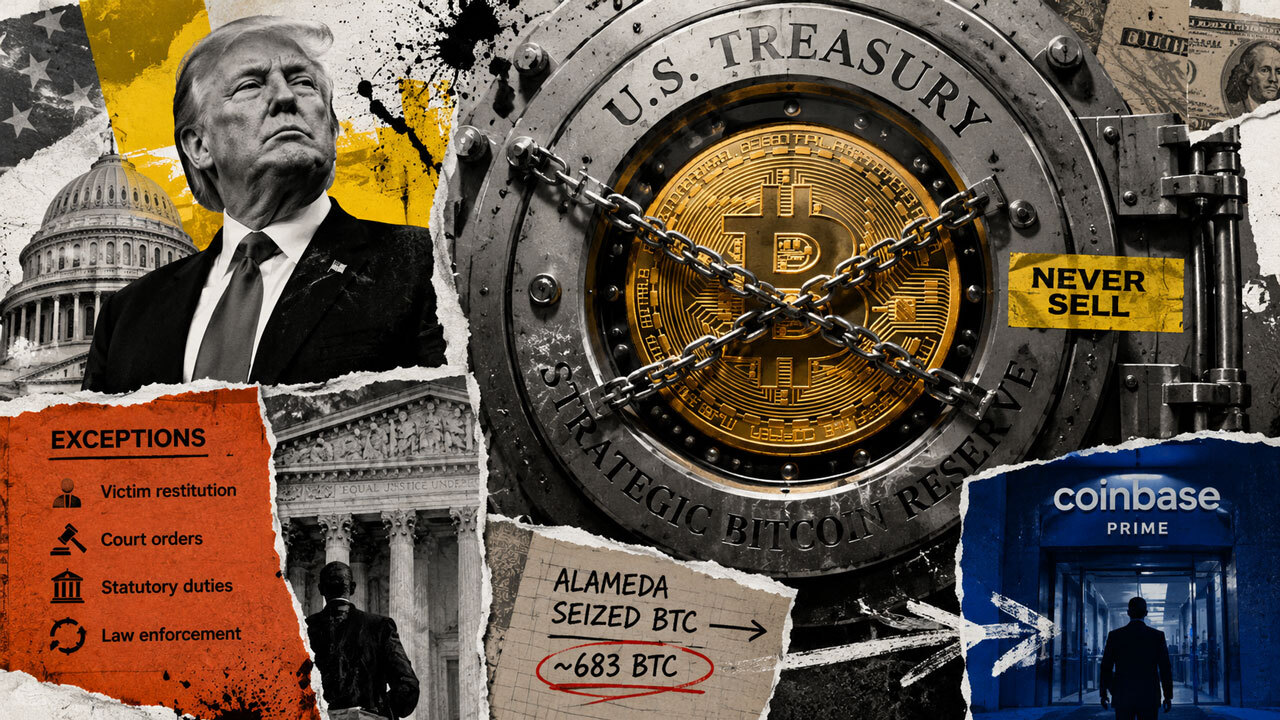
A wallet identified as belonging to a US government agency transferred roughly 1.38 BTC that originated from the Alameda Research seizure at Binance.US. The move has revived concerns that Washington could be preparing to liquidate part of its forfeited Bitcoin holdings.
What the executive order says
President Donald Trump’s March 2025 executive order created a “Strategic Bitcoin Reserve” for forfeited Bitcoin that the Treasury holds and does not need for statutory obligations. The order states that Bitcoin deposited in the reserve “shall not be sold,” making it a permanent Treasury asset. However, the order also lists several exceptions, including:
- Return or disposal to compensate identifiable victims.
- Disposition under court orders or statutory forfeiture‑fund requirements.
- Use for law‑enforcement operations.
Legal categories of seized crypto
The seized assets fall into distinct legal categories:
- Seized BTC: Held in custody during an investigation; not automatically part of the reserve.
- Forfeited BTC: Transferred to the Treasury after a criminal or civil forfeiture; may qualify for the reserve if not needed elsewhere.
- Victim‑restitution BTC: Can be sold or transferred to compensate victims under the order’s exceptions.
- WBTC and other non‑BTC assets: Managed separately in a “Digital Asset Stockpile” and not covered by the reserve’s sale ban.
Alameda Research seizure details
Court records in US v. Bankman‑Fried list approximately 682 BTC seized from two Alameda accounts at Binance.US, plus a later 1.38 BTC movement that brings the total to about 683.71 BTC (≈ $53.6 million at a price of $78,463 per BTC). The Department of Justice has already used portions of the broader $11 billion forfeiture order to pay victims, including a $627.9 million settlement in FY 2025.
What the recent transfer could indicate
The small BTC movement may represent one of three possibilities:
- Administrative custody shift: Coins moved for consolidation or accounting without any intent to sell.
- Absorption into the reserve: The BTC becomes part of the Strategic Bitcoin Reserve, reinforcing the “permanent asset” claim.
- Disposition for restitution: The BTC is sold or transferred to compensate victims, which is permitted under the executive order but falls outside the reserve’s protection.
Why the distinction matters
Public trackers estimate US‑controlled Bitcoin between roughly 198,000 and 328,000 BTC, a gap of about 130,000 BTC (≈ $10.2 billion). The lack of transparent accounting for which coins are locked in the reserve versus which are earmarked for restitution fuels uncertainty about the government’s ability to liquidate its holdings.
Source & attribution
News Source
- Publisher
- CryptoSlate
- Original date
- August 27, 2026, 10:30 AM
- Original headline
- How one small BTC transfer exposed the fine print behind Trump’s ‘never sell’ strategic Bitcoin reserve