Crypto news report · source clearly identified
Sixth Circuit Rules Ohio and Tennessee Can Enforce Gambling Laws on Kalshi’s Sports Contracts
A unanimous Sixth Circuit panel rejected Kalshi’s claim that federal oversight preempts state gambling statutes, directing the exchange to block users in Ohio and Tennessee and to use geofencing to comply with state rules.
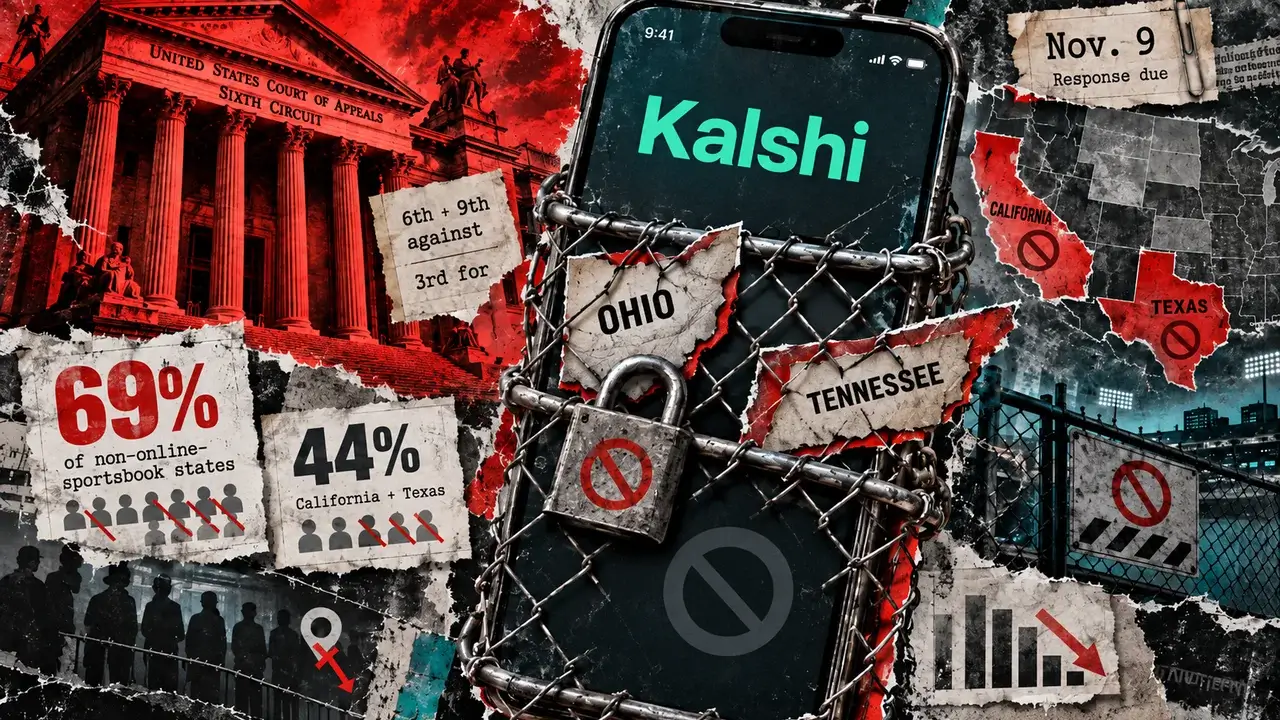
The U.S. Court of Appeals for the Sixth Circuit issued a decision on September 25 that Ohio and Tennessee may apply their gambling regulations to Kalshi’s sports‑contract offerings. The court dismissed Kalshi’s argument that complying with state‑by‑state rules would conflict with its duties as a federally regulated designated contract market.
Legal Findings
- Kalshi failed to demonstrate that its sports contracts satisfy the Commodity Exchange Act’s definition of a swap.
- Even if the contracts were classified as swaps, the court held that federal commodities law does not preempt state gambling statutes.
- The ruling allows states within the Sixth Circuit to enforce their gambling laws regardless of any later determination on the swap question.
Geofencing as a Viable Solution
The panel noted that other exchanges successfully use geographic segmentation (geofencing) to meet both federal exchange obligations and state gambling requirements. The judges rejected Kalshi’s claim that such segmentation would be “technically difficult, time‑consuming, and expensive,” stating that cost does not equate to impossibility.
Immediate Impact
- Ohio’s earlier injunction against Kalshi was affirmed.
- The preliminary injunction protecting Kalshi in Tennessee was vacated, allowing state regulators to enforce their laws.
- Both cases have been remanded to the lower courts for further proceedings.
The decision now applies to federal courts handling Kalshi matters in Ohio, Tennessee, Michigan and Kentucky. Separate state‑court actions continue in Michigan and Kentucky.
Market Exposure
Modeling by Eilers & Krejcik Gaming estimates that 69 % of Kalshi’s retail sports demand originates from states without legal online sportsbooks, with California and Texas alone accounting for 44 % of that demand. In competitive legal betting states, prediction‑market contracts are estimated to have displaced only 2 %–4 % of sportsbook handle.
Broader Judicial Landscape
- Third Circuit (New Jersey) – favorable to Kalshi.
- Ninth Circuit (Nevada) – ruled against Kalshi.
- Sixth Circuit (Ohio, Tennessee) – ruled against Kalshi.
- Fourth Circuit (Maryland) – pending.
New Jersey has petitioned the Supreme Court to resolve the split, but the Court has not yet agreed to hear the case. Kalshi’s response to the Sixth Circuit ruling is now due November 9.
What Lies Ahead
If the Supreme Court ultimately adopts the Third Circuit’s view, Kalshi could operate a nationwide market under a single federal framework. Conversely, if the Sixth and Ninth Circuits’ reasoning prevails, Kalshi will need to maintain a state‑by‑state compliance matrix, potentially limiting liquidity and shaping its product offerings across jurisdictions.
Source & attribution
News Source
- Publisher
- CryptoSlate
- Original date
- September 26, 2026, 12:30 PM
- Original headline
- Kalshi must lock out state users after major court loss