Crypto news report · source clearly identified
MetaMask and ConsenSys Split Highlights Divergence Between Ethereum Adoption and ETH Demand
ConsenSys will separate MetaMask from its infrastructure arm, creating distinct businesses for the consumer wallet and for public‑ and private‑Ethereum software. The move underscores how different product lines generate fees that may or may not translate into demand for ETH.
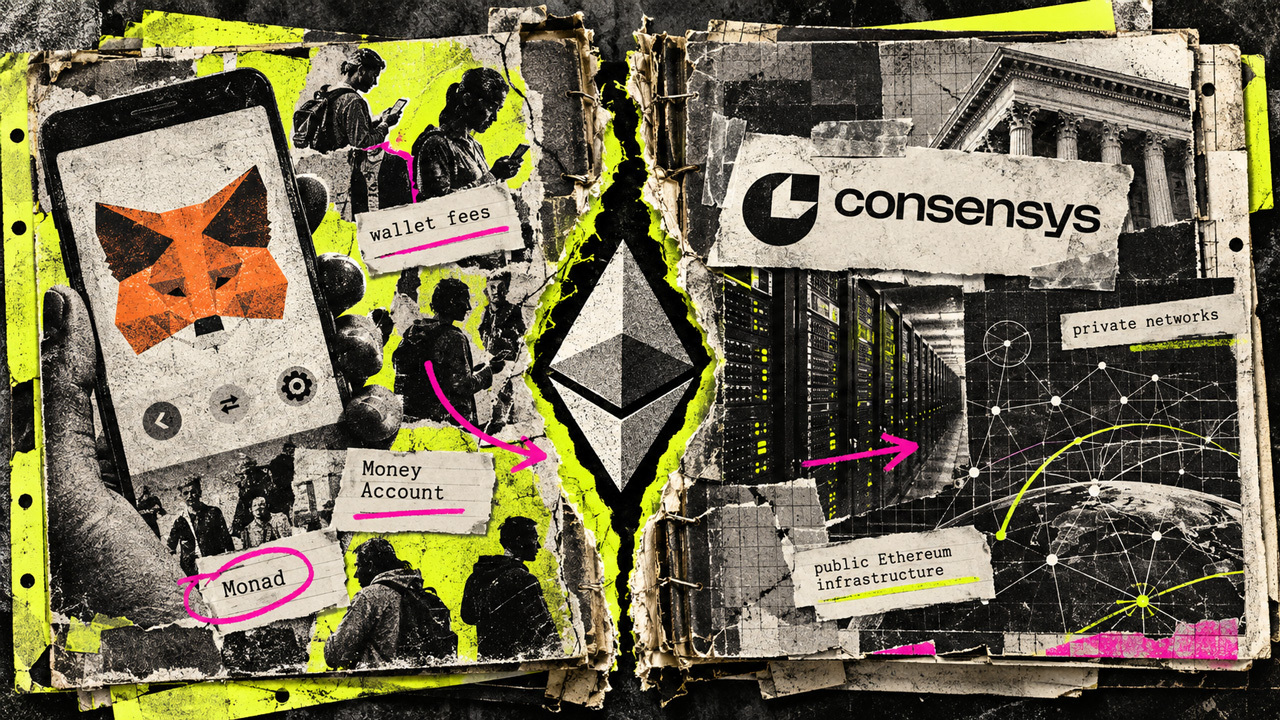
ConsenSys announced that MetaMask will operate as an independent entity separate from the company’s Ethereum infrastructure business. The split, slated for completion by the end of 2026, creates two parallel tracks: a consumer‑focused wallet and a suite of software tools for both public Ethereum and private, permissioned networks.
Structure of the separation
Under the new arrangement, the existing ConsenSys Software Inc. will continue as MetaMask, while a newly formed ConsenSys company will take over the infrastructure portfolio, including the Linea blockchain and clients such as Besu and Teku. Joe Lubin will remain chairman and CEO of MetaMask and serve as executive chairman of ConsenSys; Mike Kriak will be ConsenSys’s CEO.
Wallet economics versus network fees
MetaMask’s fee model separates the wallet’s service charge (0.875% on swaps) from the underlying network fee paid to Ethereum miners/validators. The wallet fee reflects revenue for MetaMask, not direct ETH fee income. Consequently, higher swap volume can grow the wallet business without necessarily increasing ETH demand.
Money Account and the Monad network
MetaMask’s Money Account, launched on June 30, converts deposits into the mUSD stablecoin and runs on the Monad blockchain, a private network distinct from Ethereum Mainnet. Deposits are placed in a DeFi vault managed by Veda and curated by Steakhouse, offering yield that is unrelated to ETH gas fees. The product’s returns are variable and carry smart‑contract and liquidity risks.
Private‑network infrastructure
ConsenSys’s infrastructure includes Besu, which supports permissioned networks that use proof‑of‑authority consensus and separate chain identifiers. Transactions on these networks do not incur Ethereum Mainnet gas fees, even though the software is Ethereum‑compatible.
Implications for ETH demand
Only activities that execute on Ethereum Mainnet generate ETH‑based gas fees. On Mainnet, the base fee is burned (reducing supply) and the priority fee goes to validators. Public‑layer solutions such as Linea still use ETH for gas, allocating a portion of fees to ETH burning, but this does not automatically translate into measurable ETH demand across all ConsenSys products.
What investors and users should watch
- Which network a transaction uses (Mainnet vs. private chain) determines whether ETH is spent.
- The distribution of fees between wallet services and network gas fees clarifies the true impact on ETH.
- Growth in MetaMask’s user base can boost wallet revenue without directly increasing ETH consumption.
- Private‑network adoption may be commercially significant while remaining largely independent of ETH economics.
Source & attribution
News Source
- Publisher
- CryptoSlate
- Original date
- September 10, 2026, 9:00 PM
- Original headline
- MetaMask and Consensys split exposes the gap between Ethereum adoption and ETH demand