Crypto news report · source clearly identified
Hazync Prototype Shows 27 ms Bitcoin Block Verification but Requires Massive GPU Compute for Full Chain
A Hazync developer demonstrated a 27‑millisecond verification of a 1.7 MB receipt covering Bitcoin blocks 1‑1,789, while estimating roughly 17 GPU‑years of compute to generate proofs for the entire blockchain.
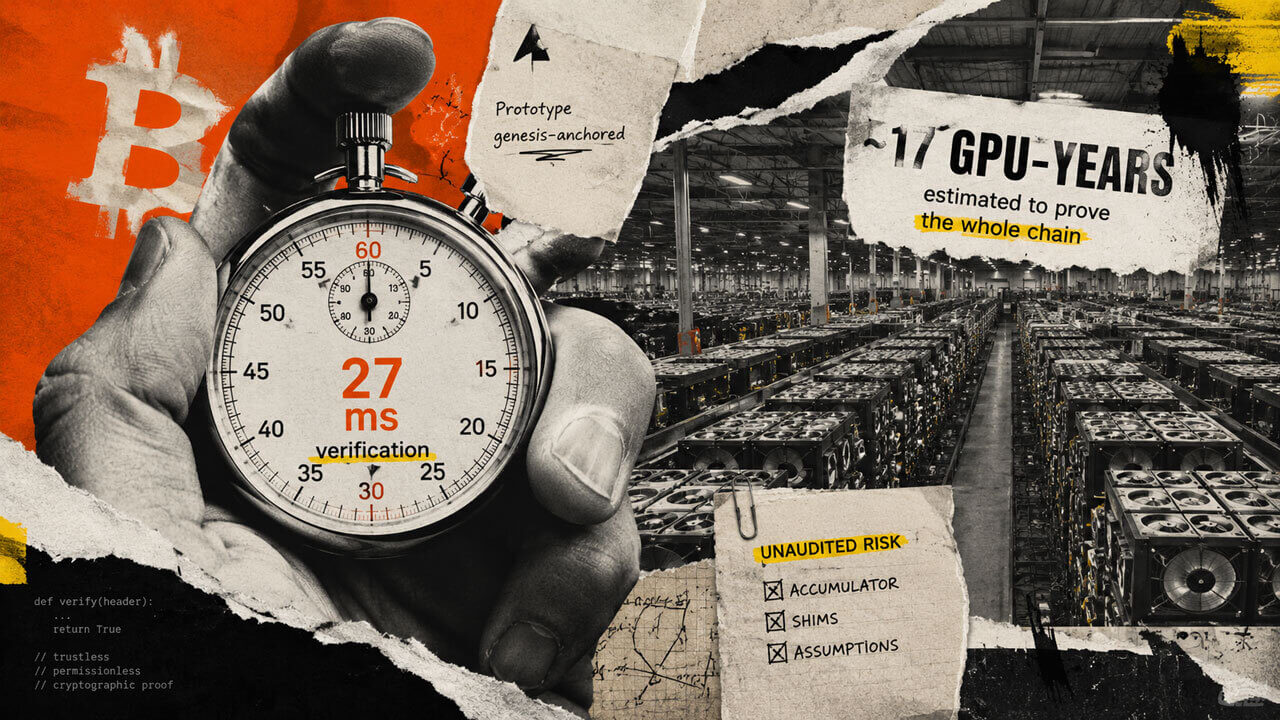
A Hazync developer reported that a 1.7 MB standalone verifier checked a 226,434‑byte zero‑knowledge receipt for the first 1,789 Bitcoin blocks in just-jst">just 27 ms. The prototype uses RISC Zero’s zkVM to run Bitcoin’s consensus rules, produce a compact receipt, and allow anyone to verify validity cheaply.
How Hazync Works
Hazync runs Bitcoin Core v28 consensus code and libsecp256k1 inside a 32‑bit RISC‑V zkVM. The program generates a receipt that proves each covered block follows Bitcoin’s rules. Verification of the receipt is fast, while proof generation (the “proving” step) is computationally intensive.
Performance Benchmarks
- Verification of the 1,789‑block receipt: 27 ms.
- Proof generation for block 741,000 (670 inputs, 394 UTXO leaves) required 55 minutes on two Nvidia L40S GPUs, including 27 minutes for aggregation.
- Based on this benchmark, the developer estimates about 17 GPU‑years to produce proofs from the genesis block to the current tip.
- Ongoing proof generation for new blocks would need capacity roughly equivalent to six Nvidia L40S GPUs.
Limitations and Ongoing Work
The 27 ms verification applies only to the early segment of Bitcoin’s history; a full‑chain proof campaign is still incomplete. Changes to the zkVM guest program reset the proof baseline, meaning earlier receipts become tied to a previous METHOD_ID and cannot be reused after updates.
Implications for Bitcoin Nodes
While receipt verification is cheap, the heavy proving cost must be borne by provers, auditors, or archive operators. Archive nodes still need to store transaction data and witness information, as receipts do not replace raw blockchain data. Chain selection still follows Bitcoin’s most‑work rule; receipts only confirm rule compliance for the segment they cover.
Security and Review Status
The project’s code is public, and two AI‑assisted external reviews in August found no obvious way for the guest program to accept an invalid chain. However, a professional audit has not yet been completed, and the proof system relies on assumptions about RISC Zero’s zkVM, SHA‑256, and secp256k1.
Source & attribution
News Source
- Publisher
- CryptoSlate
- Original date
- August 22, 2026, 8:45 PM
- Original headline
- Reaching instant 27ms validation on Bitcoin will take 17 GPU years of compute power