Crypto news report · source clearly identified
Rising Price Manipulation Attacks Increasingly Hurt Crypto Traders and Lenders
Besides organic growth and pump-and-dump schemes, there’s another increasingly popular yet malicious reason why your crypto might be skyrocketing, as price manipulation attacks have already surpassed the results for the whole of 2025. It is hurting participants in the growing crypto-backed lending market too.
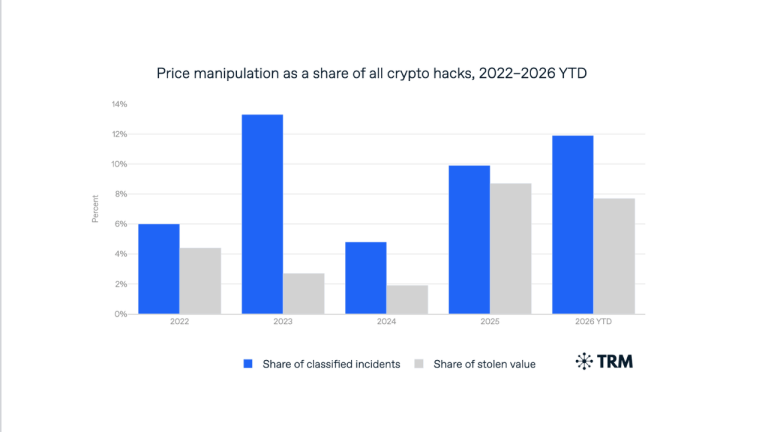
Price manipulation attacks on illiquid crypto assets are accelerating, posing new risks for decentralized lending platforms. Attackers inflate a token’s price, use it as collateral to borrow hard assets, and then let the price collapse, walking away with the borrowed funds while leaving the protocol with bad debt.
Growth of Manipulation Exploits
Blockchain intelligence firm TRM Labs recorded 32 price‑manipulation exploits in 2026, surpassing the 12 cases reported in 2025. These attacks now represent roughly one in eight hacks, up from one in 17 in 2022. The share of stolen value has stayed flat, suggesting the attacks are becoming cheaper and more repeatable, often funded by flash loans.
Weak Points: Illiquid Tokens and Oracles
Two primary vulnerabilities enable these exploits:
- Illiquid tokens – Thin markets allow rapid price inflation with modest capital.
- Oracle reliance – Protocols that price collateral directly from low‑volume markets can be deceived when the market is manipulated.
Impact on the Crypto‑Backed Lending Market
Defillama data shows the total value locked in over 570 lending protocols grew about 56% to nearly $50 billion in the past two years, while active loans nearly doubled to $29 billion. Despite a market dip after October 2025, the sector has been recovering since August 2026, providing more opportunities for attackers.
Recent High‑Profile Attacks
• Tectonic lost over $70 million when an attacker inflated the price of its governance token TONIC by 100× in roughly 20 minutes. The Cronos network later rolled back the chain, limiting the attacker’s gain to about $6 million.
• Moonwell suffered an $8.7 million loss after attackers manipulated MAMO oracle prices.
Consequences for Users
Even users who do not hold the manipulated token can suffer losses if the lending pool accrues bad debt. Recovery depends on the protocol’s ability to freeze attacker addresses, reverse transactions, or negotiate settlements. Legal recourse is uncertain; a 2025 U.S. court case involving Mango Markets highlighted challenges in prosecuting manipulation on permissionless platforms.
Governance Conflicts
Some protocols accept their own governance tokens as collateral (e.g., TONIC on Tectonic). Risk parameters are set by the same parties that benefit from price rises, creating a conflict of interest that can exacerbate losses when prices crash.
Overall, the rise of price‑manipulation attacks adds a layer of systemic risk to DeFi lending, affecting both speculative traders and users seeking stable yields.
Source & attribution
News Source
- Publisher
- Bitcoin.com News
- Original date
- September 1, 2026, 10:30 PM
- Original headline
- Rising Price Manipulation Attacks Increasingly Hurt Crypto Traders and Lenders