Crypto news report · source clearly identified
SEC and CFTC Create Limited Crypto Access Paths After Senate Blocks CLARITY Act
Following the Senate’s procedural defeat of the CLARITY Act, the SEC and CFTC each issued narrow, time‑bound exemptions that allow tokenized U.S. stocks and wallet‑linked derivatives to be offered on permissioned platforms, but the relief is conditional and limited in scope.
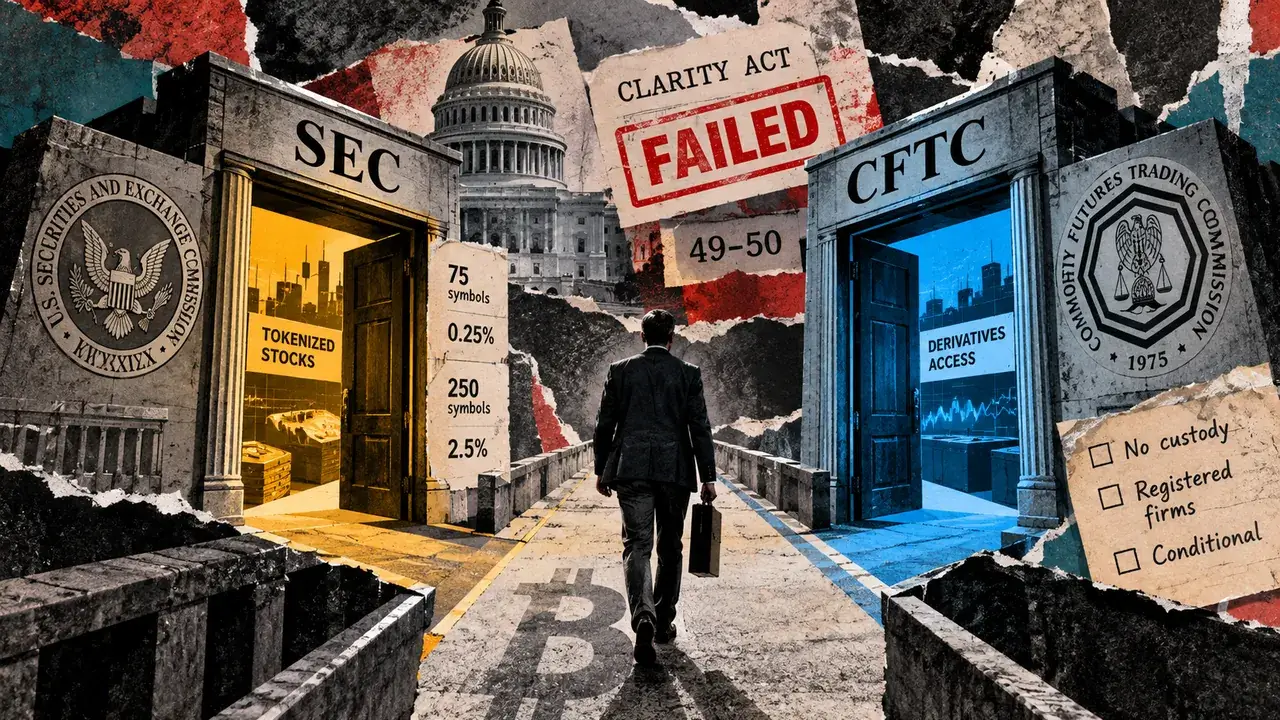
Two days after the U.S. Senate failed to advance the CLARITY Act, the Securities and Exchange Commission (SEC) and the Commodity Futures Trading Commission (CFTC) each issued limited exemptions that open narrow routes for crypto‑linked market access under existing law.
SEC’s five‑year tokenized‑stock venue exemption
The SEC created a new category called a Tokenized Securities Venue (TSV). A TSV may operate a permissioned automated market maker (AMM) that trades tokenized U.S. stocks without being classified as an exchange. The exemption runs until September 17, 2031, unless the SEC amends it.
- Tier 1 stocks: up to 75 symbols, each limited to 0.25 % of the prior month’s average daily share volume.
- Tier 2 stocks: up to 250 symbols, each limited to 2.5 % of average daily share volume.
- Tokenized shares must retain the economic and governance rights of the underlying shares, including dividends and voting.
- Issuers can object within 30 calendar days of notification; an objection blocks trading of that token on the TSV.
- TSVs must verify participants, publish transaction data, halt trading if the underlying stock is halted, and comply with existing securities‑law antifraud and antimanipulation rules.
CFTC’s staff no‑action relief for software providers
The CFTC’s Market Participants Division issued Letter 26‑25, extending a prior staff relief to any “passive” software provider that connects users to regulated derivatives markets. The relief is not a blanket exemption; it only covers activities that would otherwise require introducing‑broker or associated‑person registration.
- Providers may display market data, solicit users, and transmit user‑directed orders, but cannot hold customer assets or exercise discretion over order routing.
- Users must be onboarded directly with a registered futures commission merchant (FCM), introducing broker (IB), or designated contract market.
- Collateral for derivatives positions remains with a clearing organization or a clearing‑member FCM.
- The relief is subject to conflict‑of‑interest disclosures, record‑keeping, marketing controls, and joint liability with the registered firm.
- Letter 26‑25 is a staff position, not a binding Commission rule, and may be modified, suspended, or terminated at any time.
Implications and limitations
Both exemptions provide a way for crypto‑related products to launch without new legislation, but they stop short of establishing permanent market‑structure rules. The SEC’s TSV model is capped by symbol and volume limits and requires issuer consent, while the CFTC’s relief depends on the continued willingness of registered derivatives firms to partner with software providers.
Neither action resolves the broader jurisdictional questions between the SEC and CFTC, and both remain vulnerable to future regulatory changes. No firms have publicly committed to launch under either pathway as of the issuance date.
Source & attribution
News Source
- Publisher
- CryptoSlate
- Original date
- September 18, 2026, 12:46 PM
- Original headline
- SEC and CFTC bypass Congress to open crypto access after CLARITY fails – with a catch