Crypto news report · source clearly identified
SEC Staff Guidance Clears Path for Crypto Token Buybacks as Spend Hits $638 Million
Crypto projects have spent roughly $638 million on token buybacks through August 2026, led by Hyperliquid and Pump.fun. New SEC staff FAQs clarify that buybacks on functional networks are not automatically deemed securities, shaping a regulatory framework for future token repurchase programs.
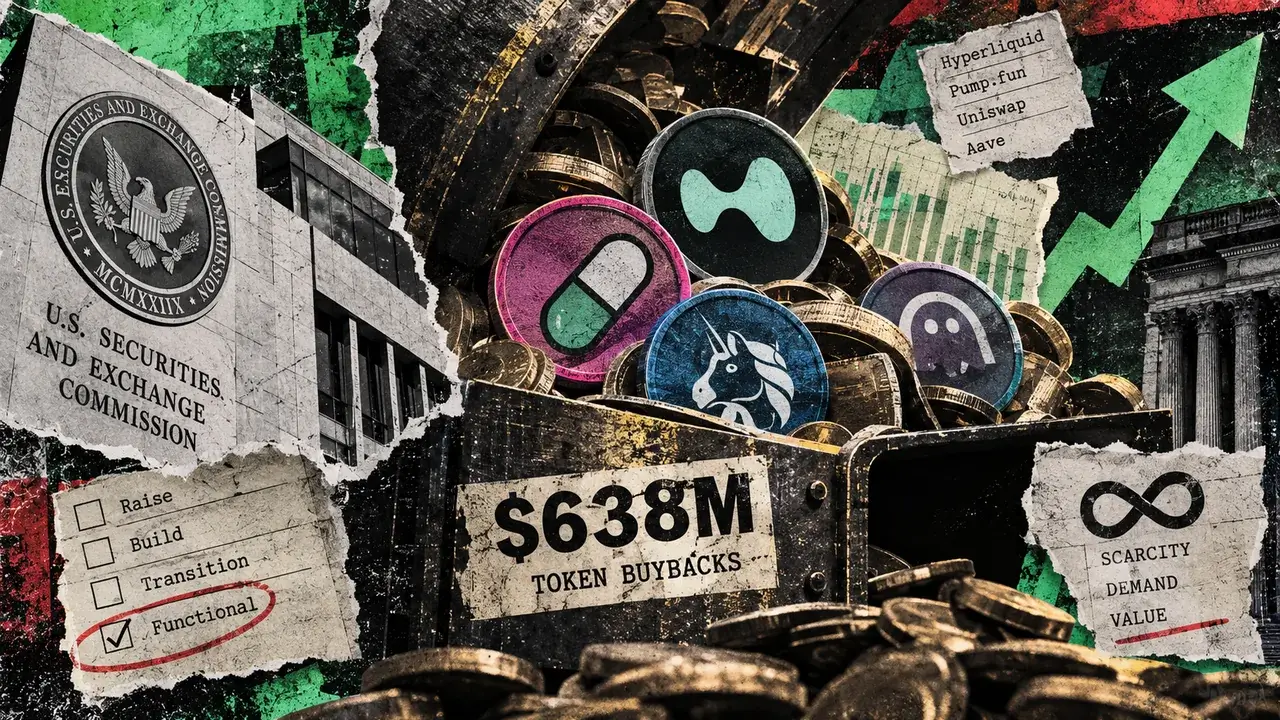
Crypto projects have collectively spent about $638 million on token buybacks through late August 2026, according to data from Allium Labs. The activity marks a record increase from $545 million in the comparable period of 2025 and is dominated by two projects: Hyperliquid, with roughly $370 million, and Pump.fun, with about $200 million, together accounting for close to 90 % of the total.
SEC Staff FAQ on Token Buybacks
The Securities and Exchange Commission’s Division of Corporation Finance issued a new set of frequently‑asked‑questions that address token buybacks on networks that are already functional. The staff view states that an issuer’s announcement of a buyback for a token that is not a security on a functional network does not fall within the “essential managerial efforts” language of the Howey test. The guidance also warns that on networks that have not yet become functional, marketing a buyback as a source of yield could trigger securities‑law analysis.
Assumptions Behind the Guidance
- The network must be functional – the token can be used for its programmed utility.
- The token must already be considered outside the scope of securities law.
These staff views are non‑binding but carry weight in the agency’s regulatory outlook.
Regulation Crypto Assets Proposal
The SEC’s pending Regulation Crypto Assets proposal would create safe‑harbor exemptions for fundraising. A startup exemption would allow up to $5 million raised over four years, while a larger exemption would permit up to $75 million annually, both with disclosure requirements. The proposal introduces Form TR, a transition filing that certifies on EDGAR that a project has completed or permanently ceased its promised managerial efforts.
The agency estimates that about 475 issuers per year could rely on this safe harbor, based on roughly 15 % of the 3,165 projects launched in 2024. Public comment on the proposal closes on October 20.
Project‑Specific Buyback Mechanics
Pump.fun allocates half of its revenue to open‑market purchases and permanent burns of its PUMP token. The project reports roughly $500 million in annualized revenue, $462.5 million in cumulative purchases, and the destruction of 167.7 billion tokens (about 16.8 % of the original supply).
Hyperliquid has bought and burned about $1.3 billion of its HYPE token since launch, with more than $1 billion in annualized fees now directed to programmatic purchases.
Uniswap collects protocol fees on Ethereum and other chains; fee collectors obtain the accumulated assets by burning UNI tokens.
Aave purchased over 205,000 AAVE tokens (≈1.28 % of supply) for roughly $42 million in its first ten months, but paused further purchases after a treasury‑budget review.
Implications for Token Holders
The SEC’s March interpretation treats tokens on functional networks as digital commodities, meaning holders do not have inherent rights to passive income or profits. Buybacks can reduce supply and create market demand, but the programs remain revocable and governed by protocol or DAO decisions.
If the Regulation Crypto Assets proposal is finalized, projects could raise capital under the exemptions, file transition reports, and direct revenue to token repurchases once their networks are functional. This would give rise to revenue‑adjusted buyback yields as a standard valuation metric for protocol tokens.
Source & attribution
News Source
- Publisher
- CryptoSlate
- Original date
- September 26, 2026, 8:20 PM
- Original headline
- SEC clears regulatory hurdle as crypto token buybacks hit record $638 million