Crypto news report · source clearly identified
Solana Governance Proposals May Halve Staking Yields and Cut Emissions by Up to $1.5 B
Two Solana proposals—SIMD‑550 and SIMD‑553—aim to double the network’s disinflation rate and increase token burns, potentially reducing staking yields to about 2.25% within three years and lowering SOL emissions by $1.4‑$1.5 billion over six years.
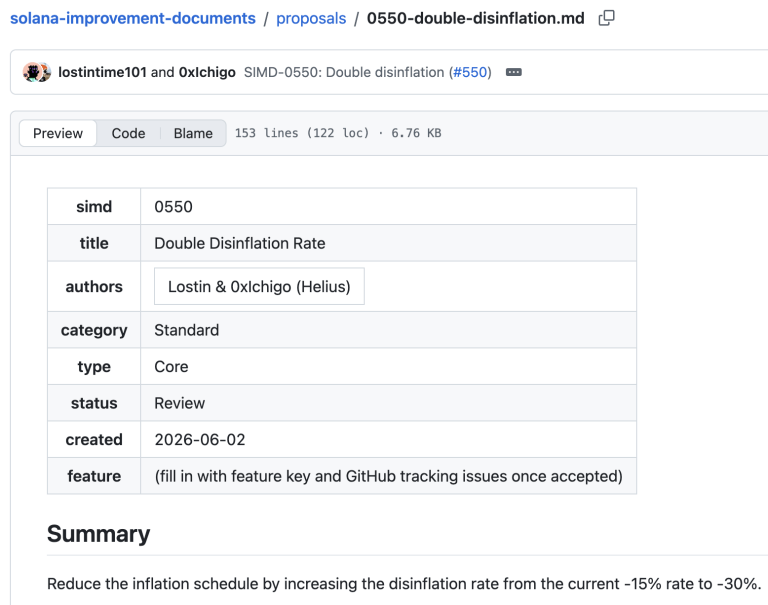
Solana’s on‑chain governance is currently evaluating two proposals that could reshape the token’s monetary policy. SIMD‑550, introduced by Helius, would raise the annual disinflation rate from 15% to 30%, while SIMD‑553, approved in July by Temporal, adds extra token burns linked to compute‑unit requests.
Impact on Staking Yields
At present, SOL staking returns roughly 5.25% per year, driven mainly by protocol inflation. Under SIMD‑550, the network would reach its 1.5% terminal inflation rate by mid‑2029 instead of around 2032. Projected nominal yields would decline to about 4.34% in year 1, 3.0% in year 2, and 2.25% in year 3.
Emission Reduction Estimates
According to Matt Mena of 21Shares, the combined effect of SIMD‑550 and SIMD‑553 could cut SOL emissions by $1.4 billion to $1.5 billion over the next six years. Daily token burns are expected to rise from roughly 600‑800 SOL to between 7,500 and 9,000 SOL, still below inflation but enough to alter the supply curve.
Validator Economics
Lower inflation reduces reward payouts, while voting costs may increase depending on the final fee structure. Estimates suggest that two validators could become unprofitable in the first year, growing to about 30 by year 3.
Potential Shift in Capital Allocation
Currently, about 67.9% of SOL is staked—almost double Ethereum’s 34.1% rate. A reduction in passive staking returns could push holders toward DeFi activities such as lending and trading, potentially boosting transaction fees, MEV revenue, and other on‑chain income streams.
Broader Market Context
Similar supply‑tightening moves, like Ethereum’s EIP‑1559 burn and Cosmos’s 2023 inflation cut, were followed by short‑term price gains, though broader market conditions also played a role. For SOL investors, the trade‑off is clear: lower immediate yield in exchange for a tighter long‑term supply profile.
Source & attribution
News Source
- Publisher
- Bitcoin.com News
- Original date
- August 27, 2026, 1:42 PM
- Original headline
- Solana Proposals Could Cut Staking Yield to 2.25%, Emissions by $1.5B