Crypto news report · source clearly identified
Aave’s “Uber Path” Strategy Highlights How DeFi Adoption Could Influence U.S. Regulation
After the Senate rejected the CLARITY Act, Aave founder Stani Kulechov urged the DeFi sector to build mass‑adopted products, arguing that widespread use could make the industry “too important to ignore.” The plan outlines consumer‑friendly accounts, institutional tokenized‑asset lending, and a proposed securities‑finance architecture, each exposing distinct regulatory touchpoints.
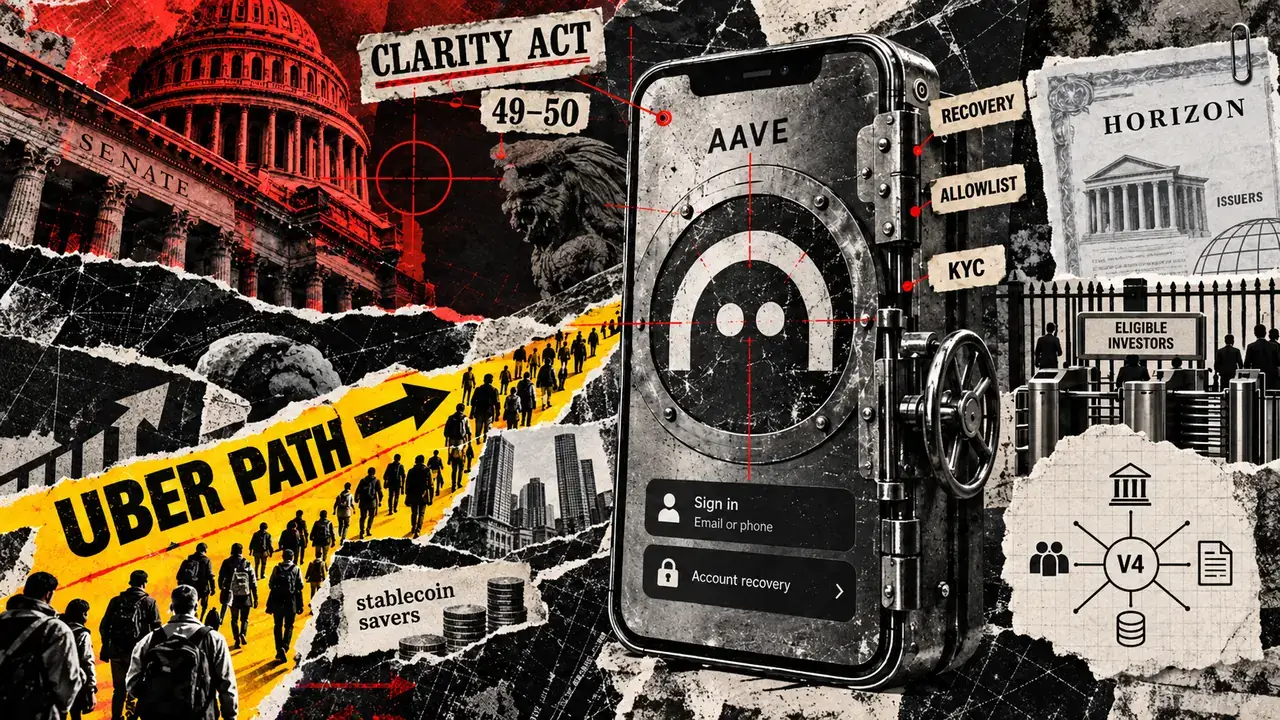
On September 15, the U.S. Senate voted 49‑50 against cloture on the CLARITY Act (H.R. 3633), a bill intended to create a federal digital‑asset market‑structure framework. The procedural defeat halted the bill’s immediate progress but did not eliminate existing regulatory authority over digital‑asset activities.
Stani Kulechov’s “Uber Path” Response
Within minutes of the vote, Aave founder Stani Kulechov posted on X that DeFi should respond by building products that millions want, coining the term “The Uber path.” The phrase describes a political strategy: mass adoption could create a constituency that pressures lawmakers, rather than a claim that popularity changes the law.
Consumer‑Facing Aave App
Aave Labs is developing a self‑custodial app that mimics modern financial apps. Users can sign in with email or phone, use passkeys, and benefit from features such as gas sponsorship, transaction batching, and pre‑authorized withdrawals. Recovery relies on encrypted key fragments stored by Aave and a third‑party provider (CoinCover). While the app remains self‑custodial, the authentication and recovery infrastructure introduces identifiable service providers, which regulators can more readily target than pure smart‑contract code.
Institutional Tokenized‑Asset Lending (Horizon)
Aave’s Horizon product enables eligible borrowers to use tokenized securities or other real‑world assets as collateral for stablecoin loans. The system separates open stablecoin supply from gated collateral access. Asset issuers, risk‑assessment services (e.g., LlamaRisk), and price‑oracles (Chainlink) perform KYC, set loan‑to‑value ratios, and validate net asset values. These identifiable actors create a regulatory perimeter around the lending process.
Proposed Securities‑Finance Architecture (V4)
Research released by Aave Labs outlines a hub‑and‑spoke model for lending against tokenized securities. A single deep‑liquidity hub could serve multiple specialized spokes, or multiple hubs could segment assets by risk category. Permissioned spokes or jurisdiction‑specific hubs would enforce KYC, asset eligibility, and location rules, translating traditional compliance functions into software parameters.
Regulatory Landscape
Even without CLARITY, existing authorities remain relevant:
- SEC can apply federal securities laws to tokenized securities and to interfaces that solicit, route, or charge fees.
- CFTC retains anti‑fraud and anti‑manipulation authority over spot digital‑commodity markets and full authority over derivatives.
- FinCEN’s guidance ties money‑transmitter obligations to the actual transmission of value, not merely software development.
- State licensing regimes vary, with frameworks such as the Conference of State Bank Supervisors and New York’s virtual‑currency rules providing additional oversight.
Political Implications
If Aave’s consumer and institutional products achieve scale, they could create a broad coalition of users, issuers, and financial firms that lobby for workable regulations rather than prohibition. Adoption alone does not determine whether a tokenized instrument is a security or a derivative, but it makes the functions subject to regulation more visible.
Key Takeaway
Aave’s strategy illustrates how DeFi can become “important enough” to shape regulatory focus. While the core protocol remains decentralized, the surrounding layers—authentication, recovery services, issuer onboarding, and permissioned venues—provide clear points for regulators to apply existing laws.
Source & attribution
News Source
- Publisher
- CryptoSlate
- Original date
- September 17, 2026, 4:30 PM
- Original headline
- Stani’s Aave “Uber plan” could turn everyday crypto savers into Washington’s worst political nightmare