Crypto news report · source clearly identified
USDC’s Quantum‑Safety Depends on the Slowest Wallet, Bridge or Blockchain
Circle warns that improving quantum attack circuits expose a coordination challenge across every host chain, wallet, custodian and bridge that supports USDC, whose market value exceeds $70 billion.
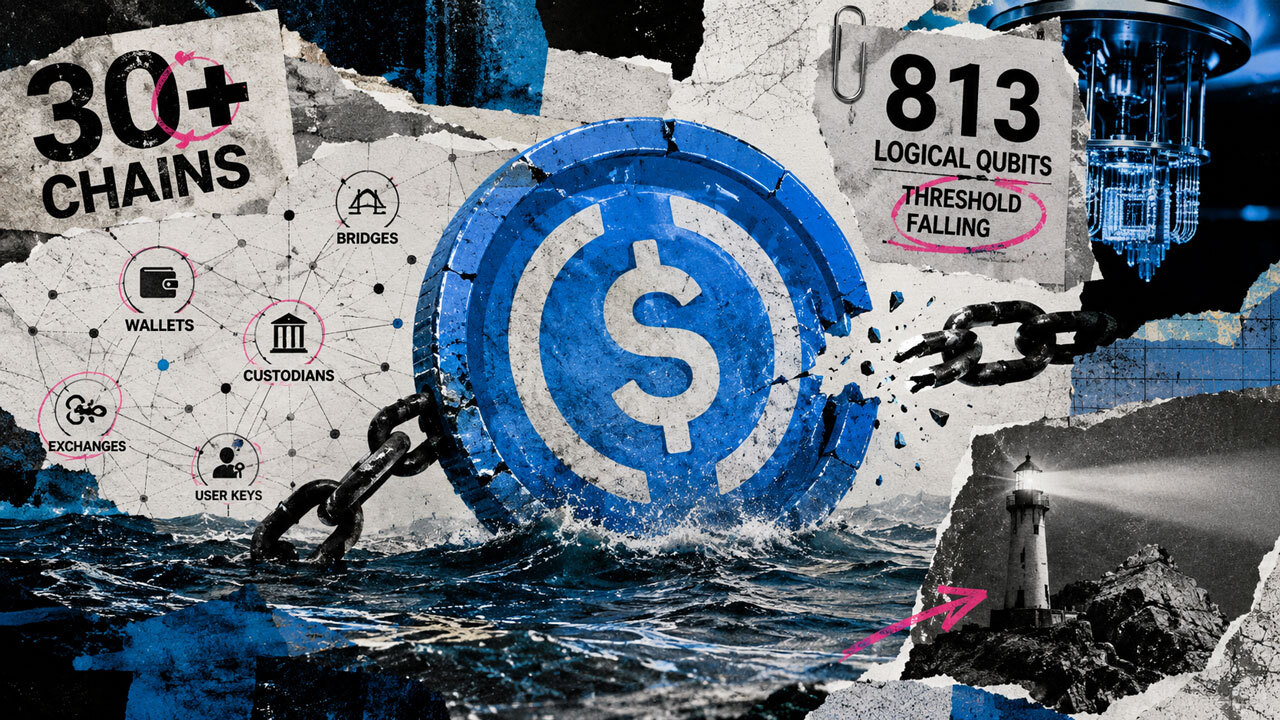
Circle has highlighted that quantum circuits capable of attacking the elliptic‑curve signatures used by most blockchains are becoming more resource‑efficient. The company cites a recent record of 813 logical qubits for a low‑width attack on the secp256k1 curve, which underpins Bitcoin, Ethereum and many other networks.
Why the Record Matters
The 813‑qubit figure shows that researchers can design smaller quantum circuits, but it does not represent a complete Shor attack. It omits circuit depth, error‑correction overhead and the physical hardware speed required to run such a circuit. A March 2026 study estimates that a full 256‑bit elliptic‑curve discrete‑log attack could be performed with fewer than 1,500 logical qubits and under 100 million Toffoli gates, assuming optimistic superconducting hardware. These models illustrate progress, not a specific timeline for a “Q‑Day.”
USDC’s Exposure Across the Ecosystem
USDC is issued on 37 mainnet networks, ranging from Ethereum and Solana to newer chains such as Algorand, Aptos and Polygon. Circle controls the token contract on each network, but it cannot rotate users’ private keys, rewrite custodian signing stacks, or unilaterally change the signature verification rules of the host blockchains.
In its August 31 disclosure, Circle urged developers to inventory their cryptography, identify vendor dependencies and prepare for key rotation. The company can secure its own signing keys and upgrade its contracts, but the broader security of USDC depends on the migration paths of every wallet, bridge and chain that currently accepts the legacy secp256k1 or Ed25519 signatures.
Migration Challenges
- Host‑chain upgrades: Each blockchain must adopt a post‑quantum verification scheme (e.g., SLH‑DSA) and deploy the necessary protocol changes.
- Wallet and custodian readiness: Wallet providers, hardware vendors and custodians need tested key‑rotation procedures and support for hybrid (classical + post‑quantum) signatures.
- Bridge continuity: Cross‑chain bridges must protect their signing keys and coordinate liquidity while both old and new signature formats coexist.
- User migration: End users must move funds to accounts that accept the new signature type before legacy paths are retired.
Because no single entity controls all of these components, the weakest link—whether a slow‑moving custodian, an unprepared bridge, or a user who never upgrades—determines the overall quantum‑risk exposure.
Circle’s Role and Limitations
Circle can:
- Rotate its issuer and contract‑administration credentials.
- Freeze or suspend addresses where its contract permits such actions.
- Coordinate timelines for its own contract upgrades.
- Change the signature verification logic of Ethereum, Solana, XRPL or any other host chain.
- Force custodians or bridges to rotate their keys.
- Guarantee that every network will adopt a post‑quantum scheme by a specific date.
Path Forward
Implementing a secure migration will require:
- Comprehensive inventories of exposed keys across all participants.
- Hybrid verification support that allows both classical and post‑quantum signatures during a transition period.
- Clear end‑state definitions so that legacy signature paths are eventually retired.
- Coordinated activation heights or protocol upgrades on each host chain.
Source & attribution
News Source
- Publisher
- CryptoSlate
- Original date
- September 2, 2026, 9:10 PM
- Original headline
- USDC may be only as quantum-safe as its slowest wallet, bridge or blockchain