Crypto news report · source clearly identified
Washington’s $115 Billion Incentive to Keep Tether in Play
Tether’s $115 billion of U.S. Treasury holdings make it a major private buyer of American debt and a key partner in Washington’s push to expand dollar use overseas.
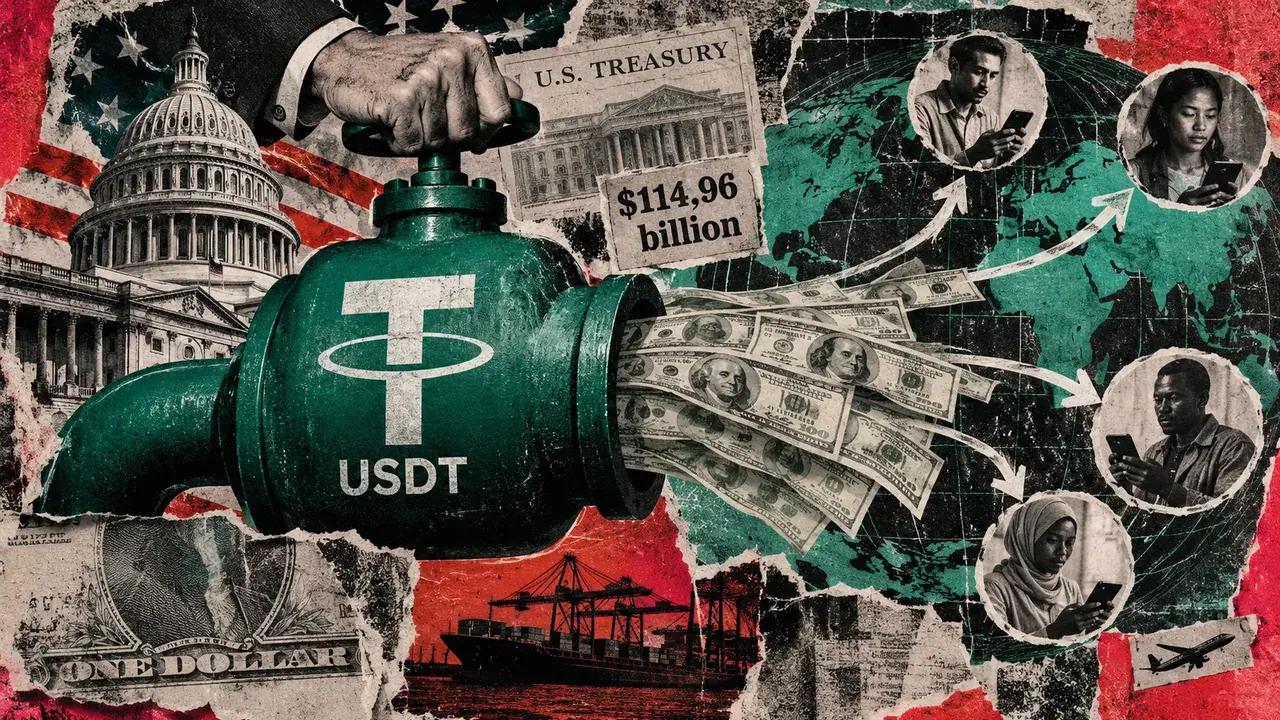
Tether has become one of the United States’ largest private customers for short‑term Treasury securities, holding roughly $115 billion in directly owned Treasury bills. That position gives the stablecoin issuer both financial clout and political relevance as Washington explores ways to spread the dollar through overseas stablecoin initiatives.
From Fine to Fiscal Partner
In 2021 the Commodity Futures Trading Commission fined Tether for misrepresenting the backing of its USDT token. Since then the company has reshaped its reserve composition, replacing commercial paper with U.S. Treasury bills and other highly liquid assets.
Reserve Composition as a Political Asset
According to its latest reserve report, Tether’s total assets stood at $187.75 billion, with liabilities of $183.64 billion, leaving a $4.11 billion excess. The bulk of the reserve is made up of:
- $114.96 billion in directly held U.S. Treasury bills (average maturity under 90 days)
- $18.63 billion in overnight reverse‑repo agreements
- $18.84 billion in precious metals
- $5.80 billion in Bitcoin
- $13.45 billion in secured loans
These holdings give Tether a dual role: a private distributor of digital dollars and a sizable buyer of short‑term government debt.
Washington’s Stablecoin Initiative
Bloomberg reported that the U.S. administration is considering an overseas stablecoin program that could involve the Treasury, the State Department, and the U.S. International Development Finance Corporation. The aim is to broaden dollar usage abroad and boost demand for Treasury securities. While no formal agreement with Tether has been announced, the company’s market share—over 60 % of the stablecoin market as of June—makes it central to any such effort.
Economic Mechanics
When users purchase new USDT, Tether receives dollars, issues the token, and invests the proceeds in its reserve portfolio. Treasury bill yields generate income, contributing to a reported $1.5 billion net operating profit for the second quarter, largely from Treasury and repo earnings.
Regulatory and Policy Context
Recent developments include:
- KPMG’s unqualified audit of Tether’s 2025 financial statements, marking a shift from earlier audit‑free periods.
- A voluntary freezing policy tied to U.S. sanctions, allowing Tether to restrict token movements at designated addresses.
- The GENIUS Act, which would impose U.S. regulatory conditions on foreign stablecoin issuers seeking access to American markets.
These steps illustrate how the U.S. government seeks both to leverage Tether’s distribution network and to retain oversight capabilities.
Implications for Users and the Dollar System
USDT provides a fast, low‑friction way for individuals—especially those without access to traditional banking—to hold and move dollar‑denominated value. While most users are indifferent to U.S. foreign policy, their reliance on a token backed by American debt extends the dollar’s reach and creates a subtle channel of influence for Washington.
Source & attribution
News Source
- Publisher
- CryptoSlate
- Original date
- September 26, 2026, 4:45 PM
- Original headline
- Washington has $114 billion reasons to want Tether around