Crypto news report · source clearly identified
Crypto industry pushes for durable regulatory rules after record $344 M political spending
Corporate political donations hit a record $646 million over the 18 months through June, with crypto spending leading at $206 million. Industry leaders now seek permanent rules on stablecoins, market structure, banking access and tax treatment.
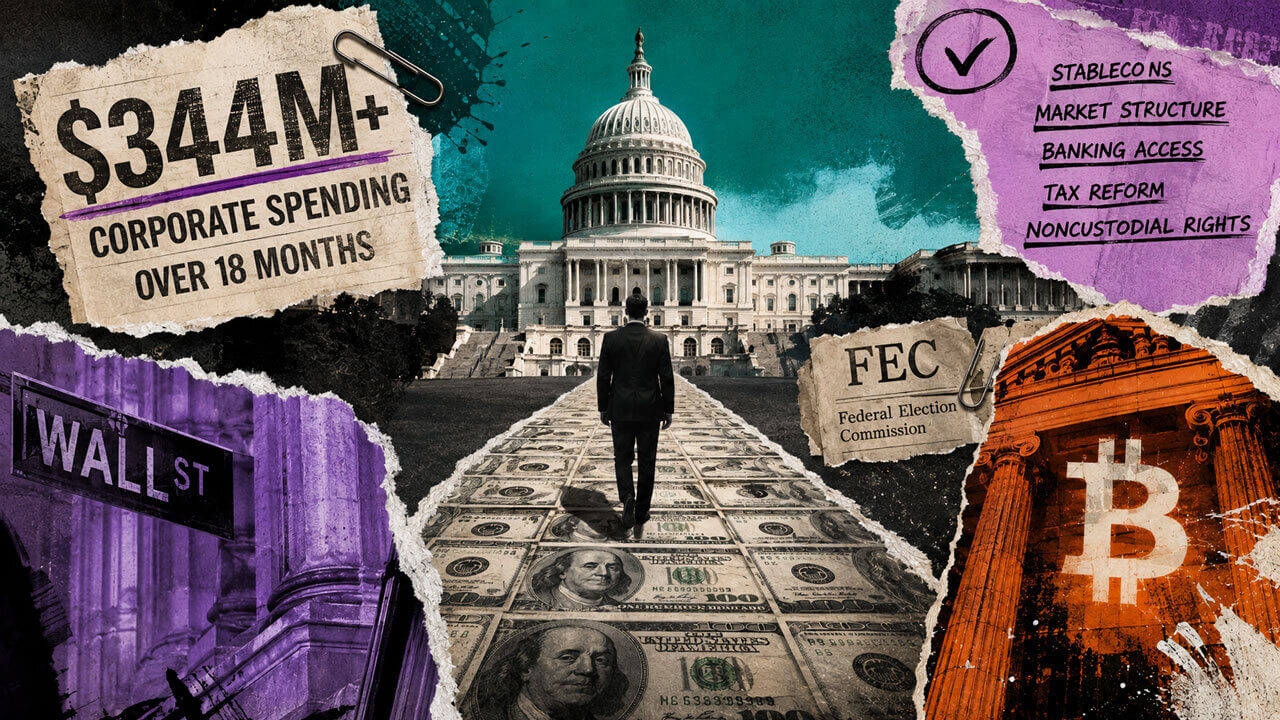
Corporate political donations reached a record $646 million in the 18‑month period ending June, according to Public Citizen’s analysis of FEC filings. Crypto‑related spending topped all sectors at $206 million, and together with AI and online betting accounted for $344 million – more than half of the total.
From short‑term lobbying to lasting rules
Founders such as Utkarsh Ahuja (Moon Pursuit Capital) say the industry has moved beyond asking for any rules. With five‑ to ten‑year business plans, investors need a regulatory framework that will not shift with each administration. The goal, according to Ahuja, is credibility and predictability for the United States.
Key legislative priorities
- Make today’s rules durable through statute rather than enforcement.
- Define whether tokens are securities or commodities.
- Lock in SEC and CFTC jurisdiction before future administrations change.
- Establish a federal stablecoin framework that remains open to new entrants.
- Secure banking charters, payment‑rail access and permission to operate.
- Protect exchanges, issuers and non‑custodial settlement infrastructure.
- Update tax rules for micro‑transactions and machine‑driven payments.
The CLARITY Act and the September 15 cloture vote
The House passed the CLARITY Act in July 2025, proposing joint SEC‑CFTC oversight of digital commodities. A Senate cloture vote on September 15 will determine whether the bill advances. If cloture succeeds and the bill becomes law, market‑structure issues could be settled before the midterms, allowing Congress to focus on banking access, tax treatment and non‑custodial protections. If cloture fails or the bill stalls, market‑structure disputes will dominate the crypto agenda through the next election cycle.
Infrastructure and stablecoin access
Industry voices such as Ryan Kirkley (Global Settlement Network) call for federal regulatory sandboxes that let startups test settlement infrastructure without the compliance costs of large banks. They also warn that the GENIUS Act’s stablecoin framework must stay workable for newcomers, lest it create an incumbent moat.
Tax and non‑custodial settlement reforms
Proposals include a de‑minimis exemption for micro‑transactions and an aggregation rule that treats a year’s worth of tiny crypto payments as a single taxable event. The Blockchain Regulatory Certainty Act, introduced by Senators Lummis and Wyden, would exempt developers and infrastructure providers that never hold user funds from money‑transmitter licensing, a protection echoed in the CLARITY Act’s language.
What’s at stake
Durable rules could give institutional capital the confidence to invest long‑term in the United States, while a failure to secure them may keep crypto policy volatile and limit the industry’s ability to integrate fully into the financial system.
Source & attribution
News Source
- Publisher
- CryptoSlate
- Original date
- September 2, 2026, 3:40 PM
- Original headline
- What the $344M crypto political spending spree wants from Congress next