Crypto news report · source clearly identified
Corporate Bitcoin Treasuries Face Hidden Conditional Supply Through Options, Collars, and Loans
Recent filings from CleanSpark, PowerCompute, and USBC reveal that corporate Bitcoin holdings are often encumbered by contracts that can trigger delivery, cash settlement, or additional debt, creating a hidden conditional supply beyond the headline balances.
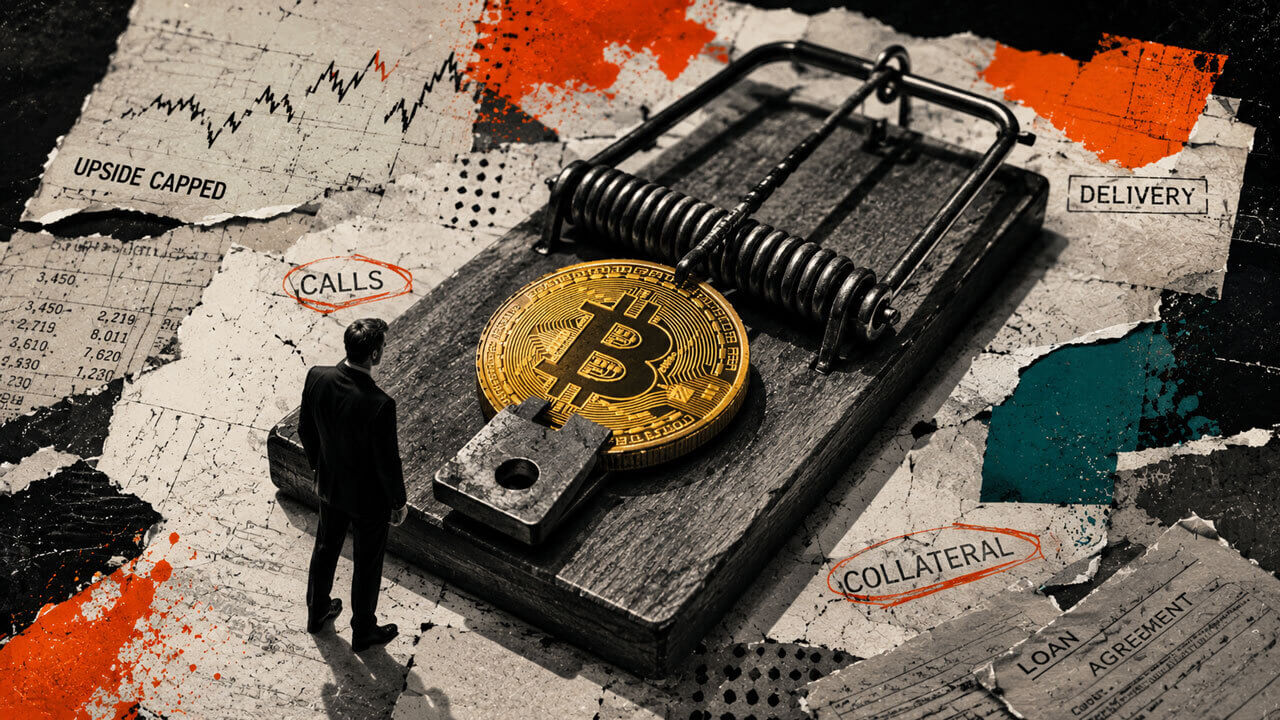
Corporate Bitcoin treasuries are increasingly tied to complex financial contracts that can convert passive holdings into future obligations. CleanSpark, PowerCompute, and USBC illustrate three distinct mechanisms—options, collar loans, and secured borrowing—that create conditional supply.
CleanSpark’s Options Activity
For the quarter ending June 30, CleanSpark recorded 9,400 Bitcoin‑equivalent call contracts through its Spot+ program. The company earned $8.017 million in premiums, with an average strike price of $76,383 when Bitcoin averaged $68,766. At period end, CleanSpark reported 12,205 BTC held and a separate receivable for 1,719 BTC posted to derivative counterparties. During June, the firm exercised 250 BTC through call exercises, acquired 25 BTC via put exercises, and executed a delta‑neutral trade for 244 BTC. These figures represent distinct categories: period activity, end‑of‑period receivable, and actual delivery or acquisition.
PowerCompute’s Collar Loan
PowerCompute entered a 30‑day collar loan on August 25, securing 307 BTC for a $21.892 million non‑recourse loan at 6.5% interest. The contract sets a $71,112 floor, a $75,000 ceiling, and a $93,500 knock‑in barrier, with a reset test on September 24. If Bitcoin trades above the barrier at reset, appreciation above the ceiling is payable to the lender, settled in BTC or cash. Below the floor, the borrower may surrender the pledged BTC, repay, or roll the loan after curing the shortfall. The loan’s exposure is tied to a single reset point rather than continuous price movements.
USBC’s Options Pledge and Credit Facility
USBC disclosed that 34.1% of its treasury was pledged for options trading, with the coins held in cold‑storage wallets controlled by counterparties. This creates a right or obligation to deliver a fixed amount of BTC, but does not imply immediate sale. Additionally, USBC has an $18 million Bitcoin‑backed loan from Payward Interactive, secured by approximately 478 BTC under a 150% initial margin. If the margin falls to 130%, a collateral call is triggered; a drop to 120% can give the lender liquidation rights if uncured.
Implications for Investors
The filings demonstrate that headline Bitcoin balances can mask significant contractual obligations. Each company’s exposure differs in timing, settlement method, and control of the coins, making a combined “unencumbered” figure misleading. Analysts must distinguish between outright holdings, derivative receivables, and collateral tied to specific contract triggers.
Source & attribution
News Source
- Publisher
- CryptoSlate
- Original date
- August 31, 2026, 6:10 PM
- Original headline
- Why Bitcoin’s $2B corporate treasuries are a ticking time bomb of hidden conditional supply