Crypto news report · source clearly identified
Bitcoin Volatility Hits Historic Low as Long‑Term Holders Dominate Supply
Bitcoin’s one‑month realized volatility is historically low, according to Glassnode, whose statistical analysis identifies long‑term holder supply as the leading explanatory variable.
Bitcoin was trading around $78,449 as it slipped below $79,000 after an attempt to stay above $80,000. Despite the short‑term price movement, Glassnode’s latest on‑chain analysis shows that the cryptocurrency’s one‑month realized volatility has fallen to a historic low.
Key Drivers of Low Volatility
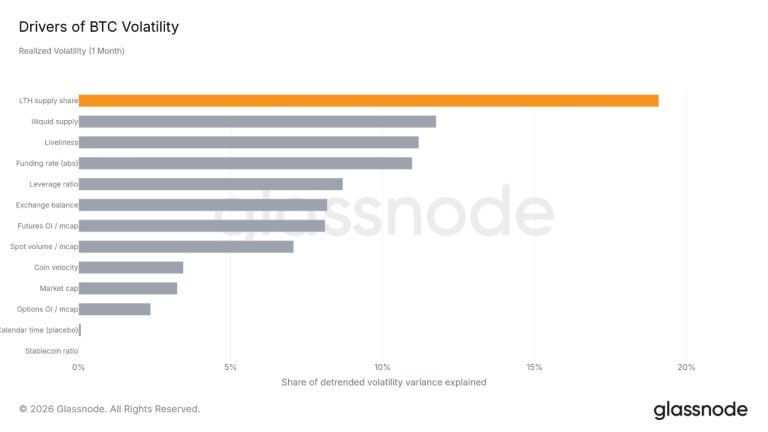
Glassnode compared 13 on‑chain and market variables to determine how much each explains the detrended variance of Bitcoin’s volatility. The results highlight the dominant role of long‑term holder supply.
- Long‑term holder supply accounts for nearly 19% of the variance.
- Illiquid supply contributes about 12%.
- Liveliness – a measure of older‑coin spending activity – explains roughly 11%.
Traditional Market Metrics Play a Minor Role
Metrics such as market capitalization, coin velocity, spot trading volume, and derivatives positioning each explain only a small share of volatility variance, ranging from about 3% to 9%.
Long‑Term Holder Supply Reaches New Highs
Glassnode defines long‑term holders as addresses that have kept BTC for at least 155 days. This cohort hit an all‑time high on July 21, holding roughly 16.64 million BTC – about 83% of the circulating supply.
Implications for Traders
A reduced liquid supply can dampen price swings when demand is stable, but it may also amplify moves if demand shifts sharply or dormant coins re‑enter the market. Low volatility periods have historically preceded strong price advances, though the relationship is correlational rather than causal.
Source & attribution
News Source
- Publisher
- Bitcoin.com News
- Original date
- September 9, 2026, 1:30 AM
- Original headline
- Bitcoin Volatility at Historic Low as Long-Term Holders Dominate