Crypto news report · source clearly identified
Cardano and Solana expose governance weakness in on‑chain voting
Simultaneous votes on Cardano and Solana reveal how voter inactivity can stall governance, with Cardano facing missed thresholds and Solana relying on validator defaults that raise representation concerns.
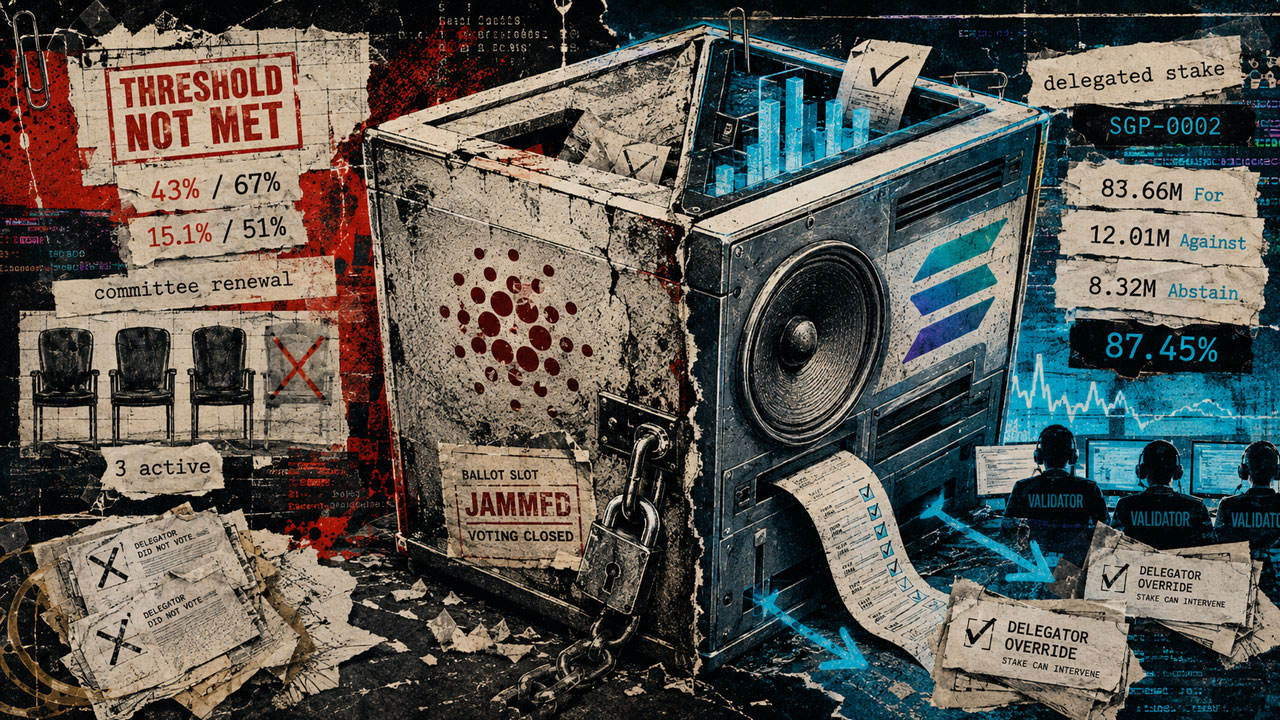
Cardano and Solana are testing two competing approaches to on‑chain governance, and recent votes highlight the cost of voter absence and the trade‑offs of delegating voting power.
Cardano’s dual‑threshold requirement
Cardano’s constitutional committee renewal must be approved separately by delegated representatives (DReps) and stake‑pool operators (SPOs). A snapshot taken on August 26 showed support well below the required thresholds: 43 % of DReps (required ≥ 67 %) and 15.1 % of SPOs (required ≥ 51 %). Both groups must meet their own thresholds, and failure by either would leave four committee terms without replacements, potentially reducing the committee below the five‑member minimum needed for committee‑dependent actions.
Solana’s validator‑default model
Solana allows validators to vote with the stake delegated to them, while individual stakers can override a validator’s choice for their own accounts. In the SGP‑0002 proposal on faster SOL disinflation, the August 26 snapshot recorded 83.66 million SOL voting “For”, 12.01 million “Against”, and 8.32 million “Abstain”. Overrides were present but represented a small fraction of the total voting weight (308 delegator voters). The vote’s outcome is ambiguous because Solana’s FAQ and its proposal repository define passage criteria differently, creating uncertainty over whether the required participation and support thresholds were met.
Economic stakes and incentive alignment
Solana Company, a publicly traded SOL treasury firm, opposed SGP‑0002. Its Q2 filing showed staking revenue of $2.512 million out of $2.526 million total, indicating that staking accounts for roughly 99.4 % of its revenue. The proposed policy would accelerate annual SOL disinflation from 15 % to 30 %, reducing issuance by about 18.9 million SOL over six years.
Implications for on‑chain governance
Both networks illustrate that delegation changes the form of participation risk rather than eliminating it. Cardano faces an immediate, measurable threat of a governance freeze if DReps and SPOs do not mobilize before the September 1 deadline. Solana’s model lowers the turnout barrier but shifts responsibility to delegators to monitor and, if necessary, override validators whose economic interests may conflict with broader token‑holder preferences.
Source & attribution
News Source
- Publisher
- CryptoSlate
- Original date
- August 27, 2026, 3:30 AM
- Original headline
- Cardano and Solana just exposed crypto governance’s biggest weakness