Crypto news report · source clearly identified
Variable-Difficulty Controllers Can Cause Bitcoin Miners to Waste Power After Power Cuts
When a miner abruptly reduces its hash rate, some share‑triggered variable‑difficulty controllers may keep the difficulty set too high, causing the miner to keep hashing with little chance of submitting a valid share and thus consuming electricity without reward.
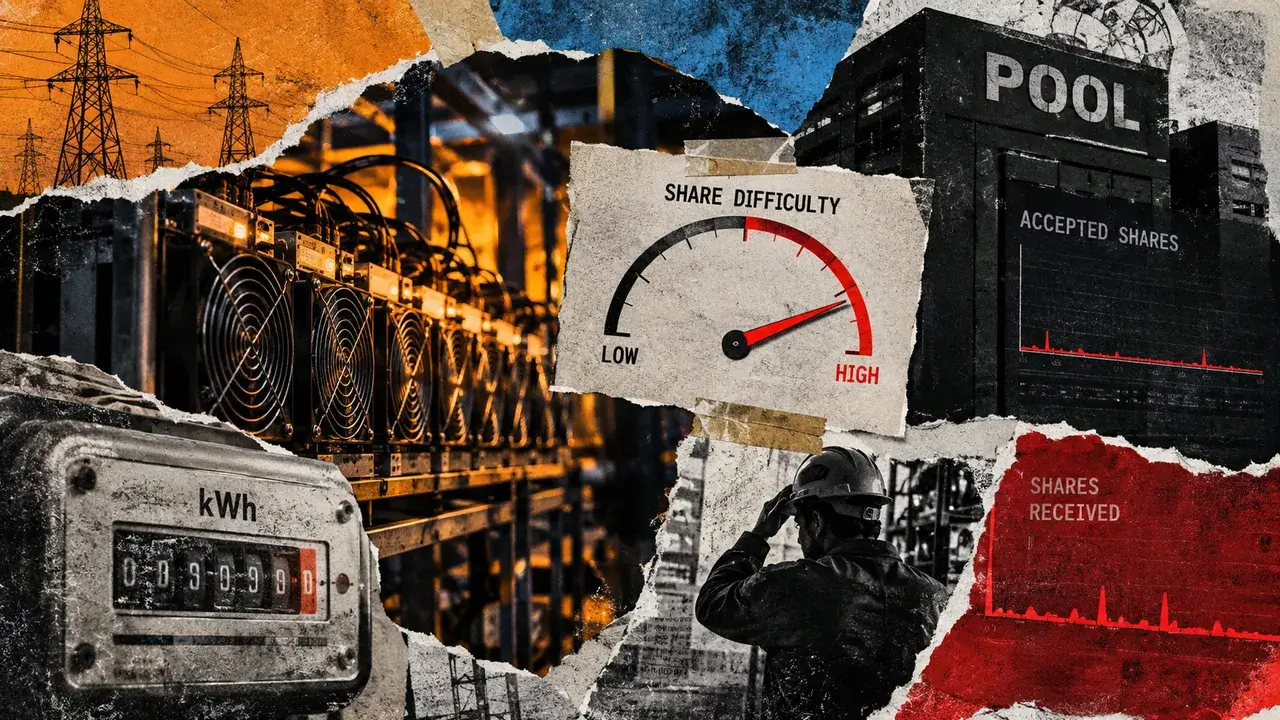
Some Bitcoin mining software that uses variable‑difficulty (vardiff) controllers can become stuck after a miner sharply reduces its hash rate. The controller continues to demand work calibrated for the miner’s previous speed, leading the miner to hash for electricity while accepted shares become extremely rare.
How the Vardiff Trap Works
Mining pools assign each miner a share difficulty that is lower than the network’s block difficulty. A vardiff controller adjusts this difficulty so that shares arrive at a useful rate. If the controller only recalculates difficulty when a share is submitted, a sudden drop in hash rate leaves the old, higher difficulty in place. Because the miner is now slower, the next share is unlikely to meet the high difficulty, so no new share arrives to trigger an update. The controller can remain stuck on the outdated difficulty, causing a prolonged period of low‑yield hashing.
Real‑World Context
The issue was highlighted by Bitcoin Optech on September 18 after mining engineer Eric Price published an analysis in July. The analysis focuses on pool‑assigned share difficulty, not the Bitcoin network difficulty, and describes a testable weakness rather than evidence of widespread losses.
Impact on Miner Rewards
Under pay‑per‑share accounting, a miner that does not submit any accepted shares during the stuck period receives no payment for that interval. Proportional accounting can shift the reward share to other participants. Some pools, such as those using Braiins’ documentation, may assign extra weight to a rare high‑difficulty share, but the immediate effect of the trap is a loss of expected credit.
Mitigations and Deployments
The Stratum V2 reference implementation includes a timer‑based recalculation that lowers difficulty during a share drought, preventing a permanent freeze. However, this behavior is not mandatory for all Stratum V2 deployments. The analysis identifies the open‑source ckpool software as an example that uses a share‑triggered approach.
Testing the Behavior
Operators can test the trap using tools like the MARA Foundation’s open‑source shape‑proxy, which can simulate step, ramp, and stall hash‑rate profiles while observing the assigned difficulty. A difficulty that remains pinned despite a falling hash rate indicates slow or absent recovery.
Open Questions
How common this behavior is in the wild and whether it has caused material losses remain unmeasured. The analysis does not link the phenomenon to specific network events, such as the January 2026 U.S. winter storm that caused a temporary hash‑rate drop.
Source & attribution
News Source
- Publisher
- CryptoSlate
- Original date
- September 21, 2026, 7:50 PM
- Original headline
- How cutting power to Bitcoin miners can actually burn more energy