Crypto news report · source clearly identified
Quarter‑Hour Bursts Drive $14 Billion of Bitcoin Perpetual Futures Trading
A study of Binance perpetual futures shows that every 15 minutes, especially at the top of the hour, trading volume and price movement spike for about ten seconds, a pattern that repeats across six major crypto contracts.
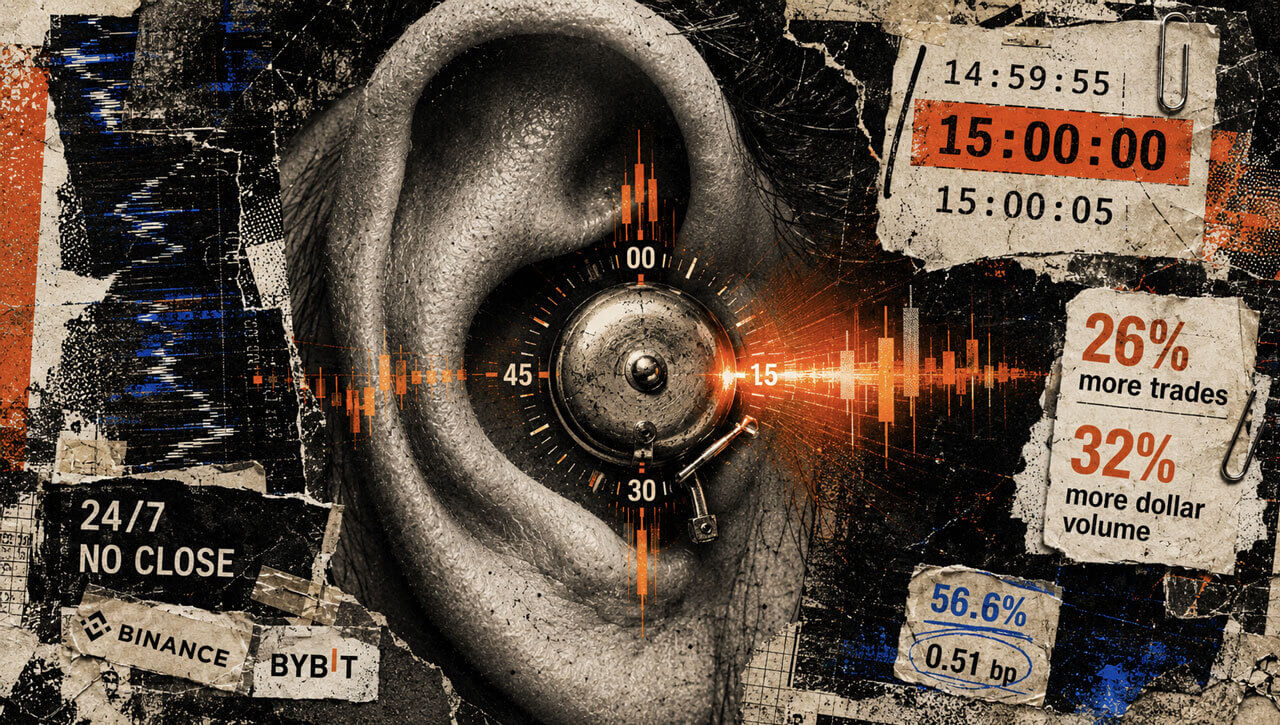
Researchers from Korea and the University of North Carolina examined over 1,400 days of Binance perpetual futures data (Jan 2021 – Oct 2024) for Bitcoin, Ethereum, XRP, Solana, Dogecoin and Cardano. They found a recurring surge in activity at minute 0, 15, 30 and 45 of each hour.
What the pulse looks like
During the first ten seconds of these quarter‑hour marks, trade count rises by 26 % and dollar volume by 32 % compared with a typical ten‑second window. Absolute price moves are also 26 % larger, indicating a more volatile micro‑session.
Why it happens
The burst aligns with common chart intervals (1‑minute, 5‑minute, 15‑minute candles) used by automated trading systems. When many algorithms reset indicators or split large orders at the same clock boundary, the market behaves like a brief opening bell, concentrating orders and price changes.
Evidence of automation
Trade‑size analysis shows a drop in round‑number orders during these bursts. For Bitcoin trades eligible to end in at least two zeros, the share of round sizes falls by 0.20 standard deviations at the top of the hour—five times the shift seen at ordinary minute boundaries—suggesting heavier algorithmic participation.
Predictive power and profitability
A rolling model using prior quarter‑hour returns and standard indicators correctly predicts the direction of the ten‑second move 56.6 % of the time (AUC 0.60). However, the average gross return is only 0.51 basis points per trade, far below Binance’s 5‑basis‑point taker fee, meaning the pattern is not exploitable for ordinary traders.
Longer‑term implications
Buyer‑initiated volume excess at a quarter‑hour boundary correlates with positive returns over the next 4‑12 hours, and the opposite holds for seller excess. This suggests the micro‑burst can signal short‑term market pressure beyond the immediate ten‑second window.
Key takeaways
- Quarter‑hour intervals generate a measurable spike in trade activity across major crypto perpetual futures.
- The effect is strongest at the top of the hour and is consistent across assets of vastly different market size.
- Round‑size order frequency drops during bursts, providing an indirect fingerprint of algorithmic trading.
- Statistical predictability exists but is too small to overcome typical transaction costs.
- Volume imbalances at these moments may inform longer‑horizon price expectations.
Source & attribution
News Source
- Publisher
- CryptoSlate
- Original date
- September 6, 2026, 11:00 AM
- Original headline
- Inside the 15-minute trading pulse that moves $14 billion in Bitcoin perpetual futures