Crypto news report · source clearly identified
Bitcoin Shows Little Correlation with Rising Bond Yields Over the Long Term
Data shows Bitcoin’s daily returns have near‑zero correlation with U.S. Treasury yields, suggesting that higher yields are not inherently bearish for the cryptocurrency, though short‑term bond market volatility can still affect price.
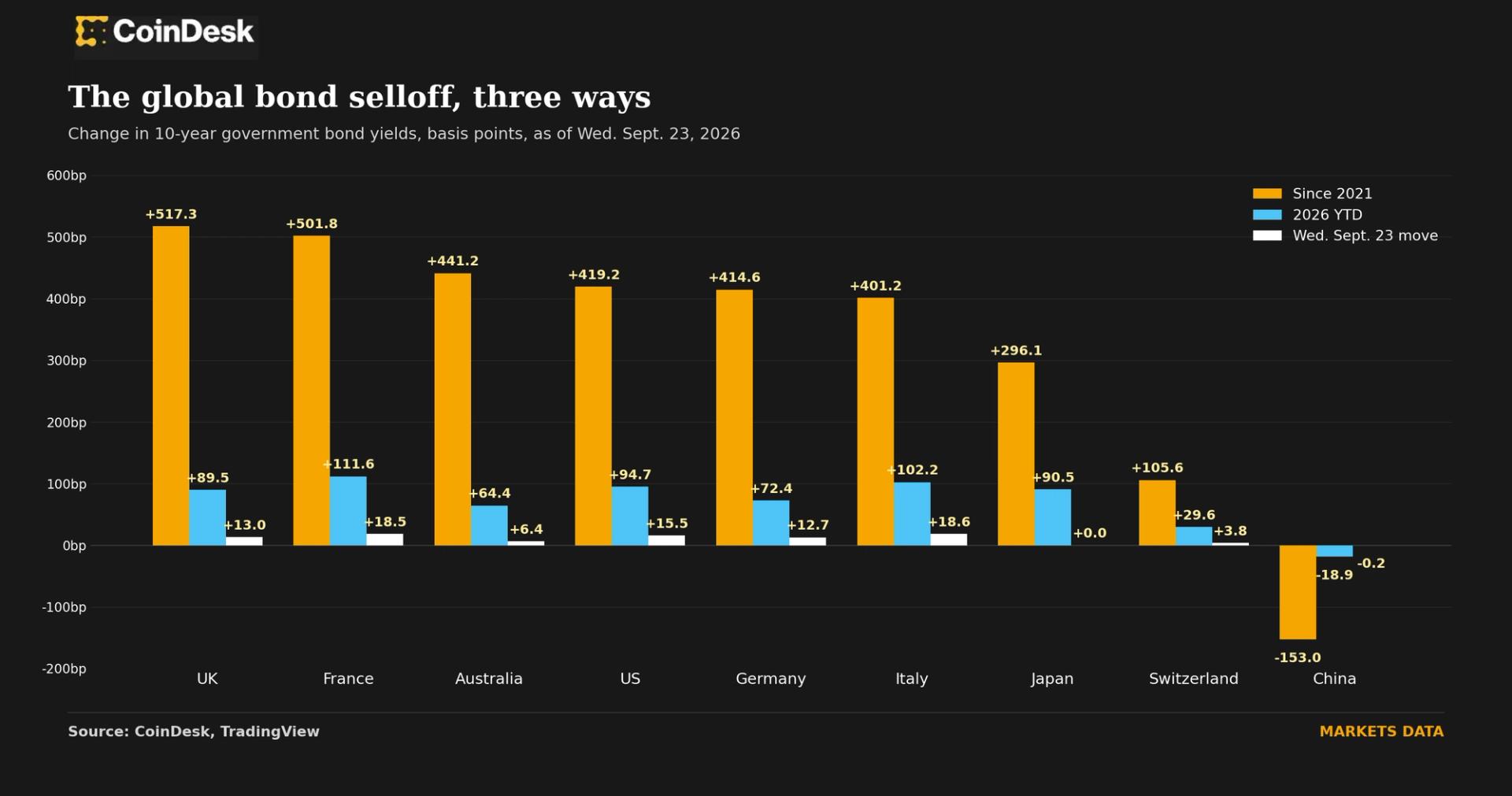
Bitcoin’s price movements have historically shown little consistent relationship with government bond yields. Over the past 90 days, the correlation between Bitcoin’s daily returns and the U.S. 10‑year Treasury yield is about –0.18, essentially flat. Longer windows—180 days and one year—show even weaker links at –0.06 and –0.03 respectively.
Long‑term independence from yields
Despite a 500‑basis‑point rise in U.S. yields and similar increases in Europe and Australia since 2021, Bitcoin has risen roughly 191% and reached a record near $126,000 in October 2023. This performance occurred while yields in the U.K., France, Germany, Italy, Japan and Switzerland all moved higher, indicating that Bitcoin does not track bond yields as a primary driver.
Short‑term impact of bond market volatility
While the correlation remains low, spikes in Treasury market turbulence can pressure Bitcoin. The MOVE Index, which measures expected Treasury volatility, jumped 21% to 95 points, coinciding with a pullback from $87,200 to $83,500. Persistent or rising volatility could trigger further short‑term corrections.
Implications for investors
Bitcoin’s near‑zero correlation with bond yields positions it as a potential diversifier in portfolios, offering risk‑adjusted return benefits similar to other alternative assets. However, traders should monitor bond market volatility, as sudden spikes can temporarily dampen crypto sentiment.
Source & attribution
News Source
- Publisher
- CoinDesk
- Original date
- September 24, 2026, 9:48 AM
- Original headline
- The data proves it: Bitcoin doesn't care about rising bond yields over long-term