Crypto news report · source clearly identified
Why Bitcoin’s rally is dangerous according to new Fed data
The index measures shock-amplification capacity, exposing funding risks that can build while spot demand remains firm.
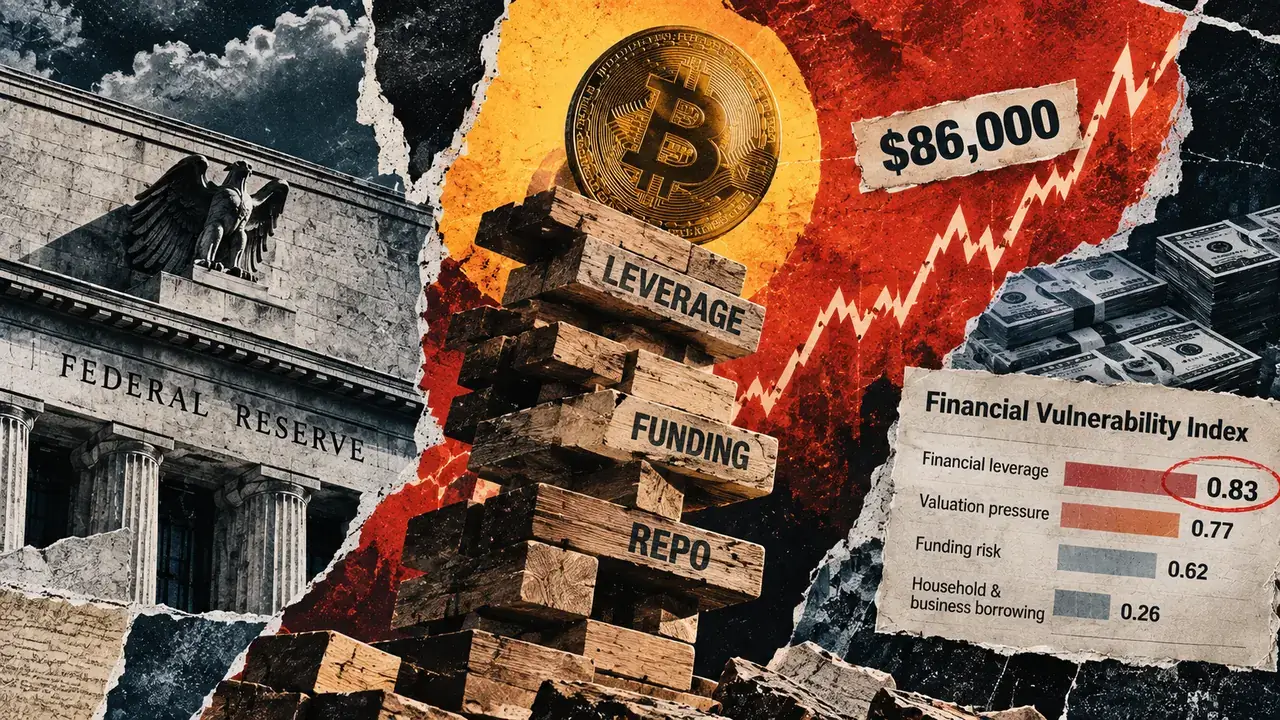
Bitcoin’s recent price surge and the Federal Reserve’s Financial Vulnerability Index (FVI) highlight different risk horizons. While Bitcoin reflects current market demand and positioning, the FVI tracks slower‑moving structural weaknesses that could amplify future shocks.
Federal Reserve’s Financial Vulnerability Index
The FVI is designed to capture long‑term vulnerability rather than immediate market stress. In the latest heatmap, the aggregate index reads 0.65, with sub‑indices showing valuation pressure at 0.77, funding risk at 0.62, and financial leverage at 0.83 – all falling in the “notable” to “elevated” ranges. Household and business borrowing remains low at 0.26.
Bitcoin’s Current Rally
On September 21, Bitcoin reached $86,000, more than 10% above the prior close. The move was driven by positive spot taker flow, rising volume, short liquidations, and elevated futures open interest. Funding rates paid by longs were above Glassnode’s high bands, and options open interest hovered around $41 billion, with options pricing less movement than the market delivered.
Potential Cross‑Market Risks
The Fed’s review of government‑bond‑backed repo markets notes that short‑term funding pressures, dealer intermediation constraints, collateral reuse, and low haircuts could transmit stress across cash, funding, and derivatives markets. Higher margin calls or tighter dealer capacity might trigger liquid‑asset sales, weaken spot demand for crypto, and force leveraged Bitcoin positions to liquidate.
Interpretation of the Index
Historical modeling in the working paper shows that periods of high FVI amplify the impact of business‑cycle shocks, leading to deeper declines in consumption and long‑term investment. The index therefore serves as an “amplifier gauge,” indicating the system’s capacity to turn a shock into broader damage, while Bitcoin’s short‑term trajectory remains tied to market flows and liquidity.
Disclaimer
The working paper reflects the authors’ analysis and does not represent an official stance of the Federal Reserve Board.
Source & attribution
News Source
- Publisher
- CryptoSlate
- Original date
- September 22, 2026, 6:05 PM
- Original headline
- Why Bitcoin’s rally is dangerous according to new Fed data