Crypto news report · source clearly identified
Senate Draft of CLARITY Act Targets Officials’ Crypto Equity Holdings
Washington came surprisingly close this week to writing a dollar amount into one of its thorniest crypto ethics rule debates. Under the final Senate draft of the CLARITY Act, senior federal officials holding equity worth at least $15,000 in certain businesses that issue or sponsor digital assets would have had to sell that interest or place it into a qualified blind trust.
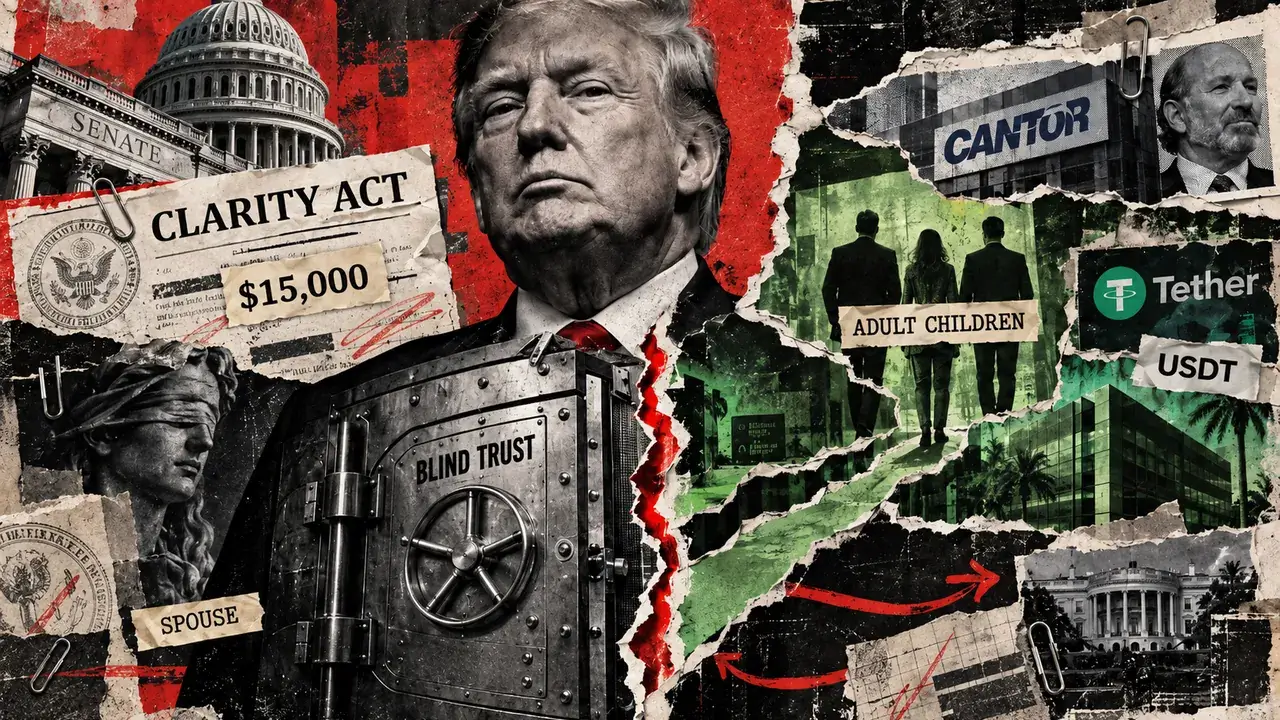
In a late‑stage Senate draft of the CLARITY Act, officials with equity of $15,000 or more in firms whose primary revenue comes from issuing or sponsoring digital assets would be required to divest or place those holdings in a qualified blind trust. The proposal also extended the requirement to spouses, while adult children were excluded.
Scope of the proposed rule
The draft focused on equity interests in businesses whose largest revenue source over the prior three years was crypto‑related, excluding tokenized traditional assets. It applied to the president, vice president, senior executive officials, members of Congress and other federal officeholders already subject to public financial‑disclosure rules.
Case study: Commerce Secretary Howard Lutnick
Howard Lutnick, former head of Cantor Fitzgerald, joined the Trump administration in February 2025. Cantor Fitzgerald has deep ties to Tether, the issuer of USDT, the world’s largest stablecoin, serving as reserve custodian and preferred primary dealer for Tether’s regulated U.S. stablecoin. Upon entering government, Lutnick stepped down from Cantor and transferred his ownership to trusts benefiting his adult children, with his son Brandon acting as controlling trustee. SEC filings show that after the October 2025 transfer, Lutnick no longer held beneficial ownership.
Family wealth versus official control
Federal conflict‑of‑interest law traditionally attributes financial interests of spouses and minor children to an official, but not those of independent adult children. The CLARITY draft reflected this distinction, prompting criticism from some Democrats who argued that it left too much room for officials’ families to remain financially linked to crypto businesses.
Blind trusts explained
A qualified blind trust requires an independent trustee and limits the official’s knowledge or control over the assets. Under the draft, assets placed in such a trust would not be attributed to the official, though the original holdings remain known until the trustee disposes of them or they fall below the threshold.
Legislative outcome
The Senate failed to advance the bill on September 15, so the provisions did not become law. Nonetheless, the language reveals ongoing debate over how far ethics rules should extend to family members of high‑level officials in the rapidly evolving crypto sector.
Source & attribution
News Source
- Publisher
- CryptoSlate
- Original date
- September 19, 2026, 9:02 PM
- Original headline
- Why Trump backed a crypto ethics rule that stopped at the family business