Crypto news report · source clearly identified
AI Data Centers Test Power‑Curtailment Techniques First Used by Bitcoin Miners
A Texas experiment showed that AI chips can drop power use by 75% in seconds without losing work, echoing demand‑response tactics long employed by Bitcoin miners.
AI workloads demand massive electricity, often rivaling the consumption of small cities. When grid capacity lags behind rapid data‑center expansion, operators must find ways to align demand with supply.
Experiment in Texas Shows Rapid Power Throttling
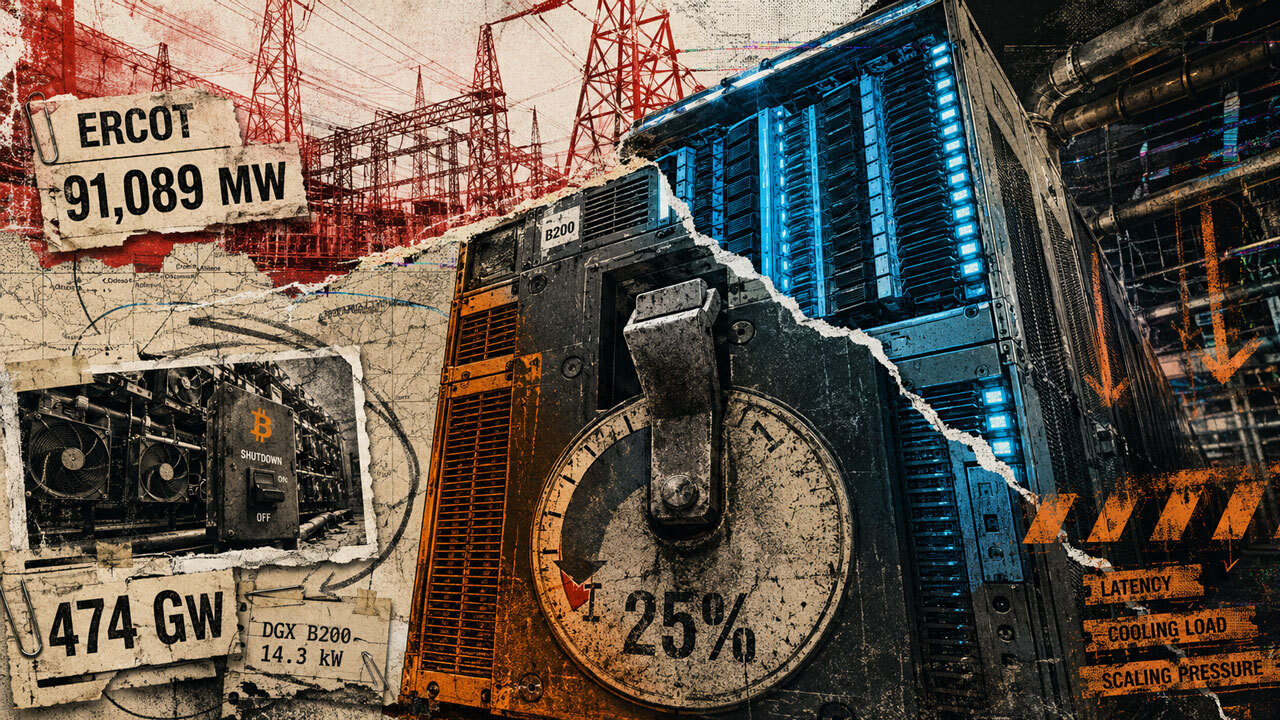
Luxor Energy, a firm with roots in Bitcoin mining, partnered with software provider Bentaus to control a single Nvidia B200 AI accelerator. When instructed, the chip reduced its power draw to roughly 25% of normal within half a second, processing fewer inference requests during the restriction. The chip resumed full speed afterward, and no jobs were lost.
Why Flexibility Matters for AI Facilities
Large AI campuses contain tens of thousands of GPUs and supporting infrastructure. If a portion of that load can be slowed or shifted when electricity is scarce, the overall demand on the grid can be reduced without compromising critical services.
Texas Grid Strain Highlights the Challenge
ERCOT reported a preliminary peak demand of 91,089 MW, enough to power over 22 million homes. Developers have applied for more than 474 GW of new electricity, with about 90 % intended for data centers. Regulators are auditing these requests because the proposed load far exceeds the grid’s current planning horizon.
Bitcoin Mining Provides a Blueprint
Bitcoin miners have long participated in demand‑response programs, shutting down when wholesale electricity prices spike and resuming when prices fall. This flexibility has been rewarded with payments and reduced transmission charges, making miners a valuable “emergency brake” for the grid.
Scaling the Approach to Full‑Scale AI Data Centers
Researchers have demonstrated that clusters of hundreds of GPUs can cut power use by 25 % for several hours while preserving performance for priority jobs. Companies such as Emerald AI have secured financing to commercialize such flexible‑AI software across multi‑megawatt facilities.
Regulatory Moves Toward Mandatory Flexibility
Texas Senate Bill 6, effective 2026, will require large power users (75 MW or more) to curtail consumption during severe grid emergencies and offers compensation for verified demand reductions.
Key Challenges Ahead
- Identifying which workloads can be delayed without breaching service‑level agreements.
- Coordinating power‑throttling across thousands of GPUs to avoid sudden rebound spikes.
- Providing verifiable meter data to grid operators to prove reliable demand reductions.
Successfully integrating these controls could turn AI’s massive electricity appetite into a manageable, time‑shifted load, easing grid stress while supporting continued AI growth.
Source & attribution
News Source
- Publisher
- CryptoSlate
- Original date
- August 31, 2026, 8:45 PM
- Original headline
- AI data centers are learning the power trick Bitcoin miners mastered first