Crypto news report · source clearly identified
Solana Fee Vote Highlights Limits of Founder Influence
A majority of SOL stake supported the fee reform, but the supermajority rule caused the proposal to fail, showing that Anatoly Yakovenko can set the agenda while validators and stakers retain final authority.
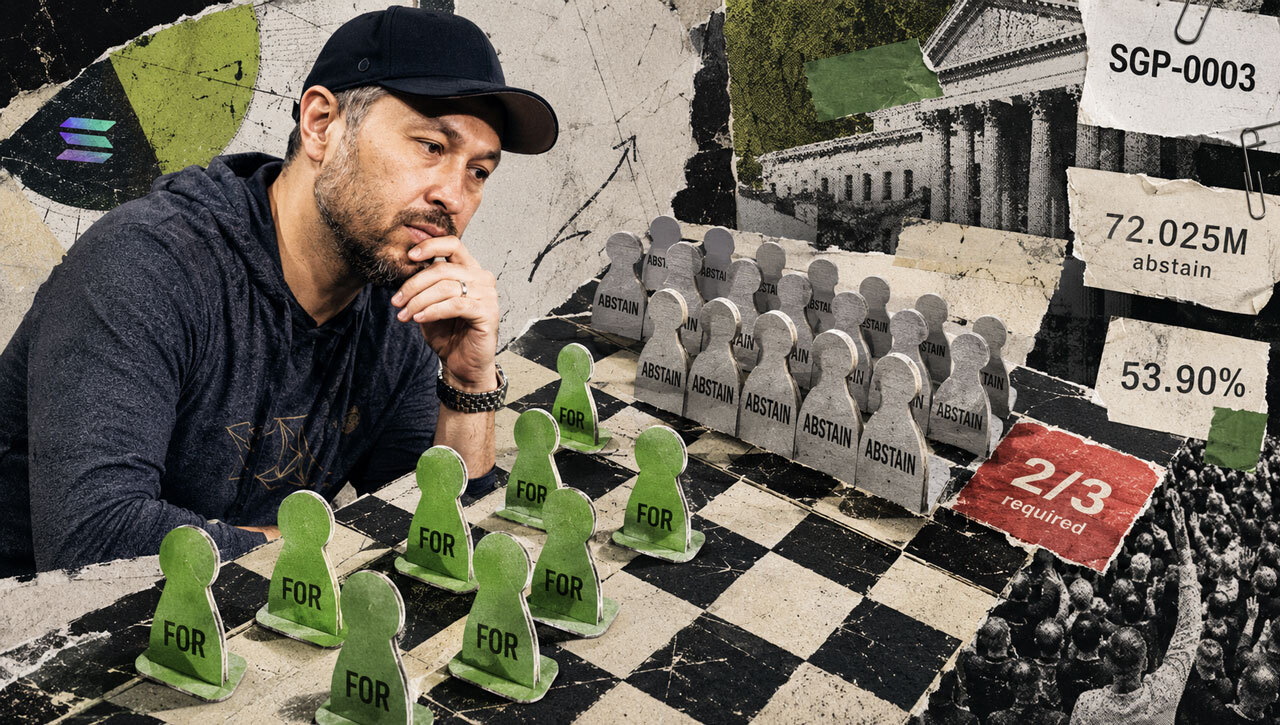
On August 28, Solana’s governance process produced an unexpected outcome: more than half of the voting stake backed the fee reform, yet the proposal was rejected because it did not meet the two‑thirds supermajority threshold.
Vote Results and Mechanics
The SGP‑0003 proposal received 142.844 million SOL in favor, 50.146 million SOL against, and 72.025 million SOL abstaining, out of 1,152 voters. In total, 265.015 million SOL (61.14 % of the 433.486 million SOL snapshot) participated, comfortably clearing the quorum requirement. However, the approval calculation included abstentions, leaving the “For” side about 33.83 million SOL short of the required two‑thirds.
Governance Rules at Play
Solana’s Constitution and current governance FAQ count votes for, against, and abstaining toward both quorum and the supermajority denominator. The frozen ballot text for SGP‑0003, which excluded abstentions, was not applied. This inclusive rule turned the large middle of the electorate into a decisive factor, making coalition breadth more important than a simple majority.
Economic Package and Founder Involvement
The proposal bundled a three‑stage fee reduction plan. It would halve the fixed signature fee from 5,000 to 2,500 lamports, introduce a resource fee based on requested compute that would be fully burned, and keep priority fees for block leaders. Founder Anatoly Yakovenko publicly supported the initial rate of one‑tenth of a lamport per cost unit, but the vote covered the entire three‑stage path.
Stakeholder Positions
- Supporters included Figment, Staking Facilities, Kiln, and P2P.org.
- Opponents included validators Jupiter, Drift, Bitwise Onchain Solutions, and Forward Industries.
- Abstentions came from a broad set of delegators, effectively raising the approval threshold.
Implications for Governance
The outcome demonstrates that while a founder can shape the agenda and provide economic arguments, the final mandate depends on a sufficiently broad stake coalition. The vote also shows that bundling multiple policy changes into a single proposal can hinder approval under Solana’s supermajority rule.
Future Path
Analysts suggest that splitting the reform into separate proposals—one for the fixed fee change and another for future rate setting—could clarify trade‑offs and improve chances of passing. Any subsequent attempt will need either a narrower technical scope, a larger supportive stake coalition, or both.
Source & attribution
News Source
- Publisher
- CryptoSlate
- Original date
- September 3, 2026, 7:00 PM
- Original headline
- What Solana’s failed fee vote reveals about Anatoly Yakovenko’s power