BTC $83,508.00 ▼ 0.83% ETH $2,689.90 ▲ 0.65% BNB $764.56 ▼ 1.74% XRP $1.50 ▼ 0.68% SOL $118.92 ▼ 2.09% TRX $0.3356 ▲ 0.66% ZEC $1,486.71 ▼ 5.39% FIGR_HELOC $1.00 HYPE $87.06 ▼ 3.95% DOGE $0.0944 ▼ 2.07% LINK $15.67 ▲ 11.95% XMR $539.63 ▼ 1.50% WBT $83.58 ▼ 0.48% ADA $0.2498 ▼ 1.73%
73 Greed

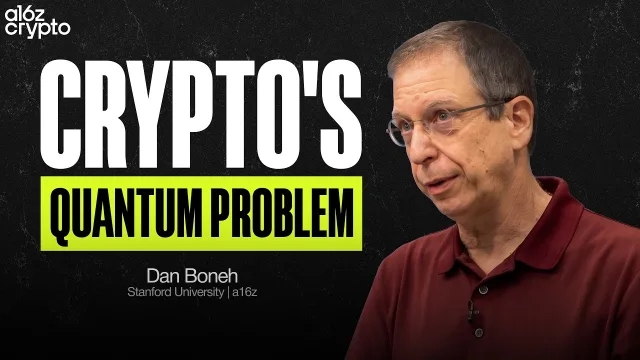
How Bitcoin Can Survive Quantum Threats – Dan Boneh Explains

Original title: How Bitcoin Survives Quantum Computers (ft. Dan Boneh)

a16z crypto 1:09:37 6,365 views on YouTube BTC −0.8% ETH +0.7%
Thumbnail for How Bitcoin Survives Quantum Computers (ft. Dan Boneh) 1:09:37

Watch on YouTube Opens on youtube.com in a new tab. Playback here uses youtube-nocookie.com.

Summary

In a lecture, Stanford cryptographer Dan Boneh explains how a sufficiently powerful quantum computer could forge the signatures that authorize BTC and ETH transactions. He argues that blockchains may need to adopt signatures built from hash functions because they are believed to resist quantum attacks. Some hash‑based schemes require wallets to track key usage carefully; if two devices fall out of sync and reuse a key, security can fail. Other designs avoid this risk but can need as many as one billion hash computations to sign a single transaction. Boneh also presents new research on threshold signing, which splits control of a private key among several parties. His approach uses lattice‑based cryptography to coordinate signers while still producing a standard hash‑based signature that the blockchain can verify. The talk ends with open questions about the transition, such as whether post‑quantum signatures will require larger blocks, how abandoned coins will be handled, and how Satoshi could prove ownership after current signatures are retired.

This AI summary uses the title, description and tags. It may miss context from the full video. How summaries are checked

Key points

  1. Quantum computers could forge BTC and ETH transaction signatures.
  2. Hash‑based signatures resist quantum attacks but may need up to one billion hash computations per transaction.
  3. Stateful hash signatures risk security if a wallet reuses a key after devices fall out of sync.
  4. Threshold signing distributes private‑key control using lattice cryptography while outputting standard hash‑based signatures.
  5. The transition to quantum‑safe signatures raises issues like larger block sizes, abandoned coins, and proof of ownership for early users.

Chapters

Chapters come from the timestamps in the video description.

A video appearing here is not an endorsement. Crypto assets can lose value. This page provides information, not investment advice.