


EIP-8025 Optional Execution Proofs in the Grandine Client
Original title: Implementing EIP-8025 Optional Execution Proofs in Grandine
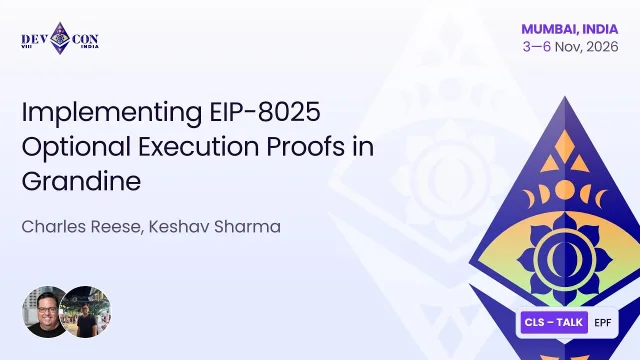
Watch on YouTube Opens on youtube.com in a new tab. Playback here uses youtube-nocookie.com.
Summary
This AI summary uses the title, description and tags. It may miss context from the full video. How summaries are checked
Key points
- EIP-8025 explores optional execution proofs that let consensus clients verify execution cryptographically.
- The source states that execution validation becomes increasingly expensive as Ethereum's gas limit rises, because every validator depends on an execution client that re-executes each payload.
- The Grandine implementation is used as a case study covering SSZ representation and payload binding, safe gossip of multi-megabyte proofs, and in-process proof verification.
- The talk covers compatibility issues that arise as EIP-8025 evolves across clients and proving systems.
- Private devnet results include SP1 proof verification through Grandine's processing pipeline, payload-mismatch rejection, and a tampering check.
Questions
What does EIP-8025 propose?
What did the private devnet demonstrate?
Who gave the talk?
Related briefs

Moscow Exchange to begin pilot Bitcoin and Ethereum trading on Dec 1
Russia's Moscow Exchange announced a pilot launch of Bitcoin, Ethereum and USDT trading on December 1. The platform will use its existing stock‑market technology and the National Clearing Centre for settlement.

Vitalik Buterin warns crypto exchanges must prioritize survival after recent hacks
Ethereum co-founder Vitalik Buterin warned that cryptocurrency exchanges must prioritize survival over market competition for the next two years.
Hackers swap fifty million dollars of stolen XRP into bitcoin
Hackers tied to a large Binance theft swapped about $50 million of stolen XRP mostly through THORChain. Blockchain analytics firm Elliptic reported that the converted amount reached 1,650 BTC.
A video appearing here is not an endorsement. Crypto assets can lose value. This page provides information, not investment advice.