


Ethereum Foundation discusses network scalability and design
Original title: What can Ethereum learn from other networks?
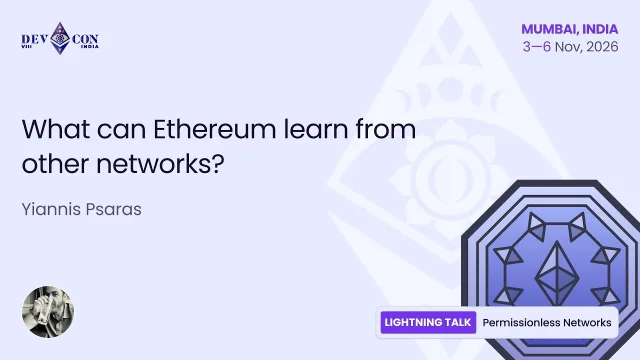
Watch on YouTube Opens on youtube.com in a new tab. Playback here uses youtube-nocookie.com.
Summary
This AI summary uses the title, description and tags. It may miss context from the full video. How summaries are checked
Key points
- Ethereum's peer-to-peer layer faces constraints from propagation latency and bandwidth.
- Transport primitives like QUIC and TLS 1.3 provide fewer round trips and stream multiplexing.
- Erasure-coded broadcast handles large payloads like blocks and blobs.
- Aggregation and batching are used for small and frequent messages.
- Solana and Iroh serve as examples of networks that use these design choices.
Questions
Who is the speaker in the video?
What track is the talk associated with?
Related briefs

Crypto exchange-traded funds face persistent outflows and shifting market volume
U.S. spot exchange-traded funds record persistent withdrawals across digital assets. Solana spot funds register consecutive weekly net outflows alongside declining spot trading volume. Meanwhile, U.S.

Crypto market rebounds as prices and short liquidations rise
The crypto market climbed 3.38% to $2.69 trillion following U.S. midterm election volatility. Bitcoin reclaimed $80,000, Ethereum moved above $2,400, and XRP recovered past $1.30.

Solana drops below one hundred dollars amid heavy exchange deposits
Solana trades below the one hundred dollar threshold as selling pressure increases across markets. Large holders deposit millions of tokens into exchanges. Spot Solana exchange traded funds record weekly net outflows.
A video appearing here is not an endorsement. Crypto assets can lose value. This page provides information, not investment advice.