BTC $84,567.00 ▼ 2.42% ETH $2,675.01 ▼ 2.49% BNB $766.43 ▼ 1.90% XRP $1.48 ▼ 3.07% SOL $119.17 ▼ 3.33% TRX $0.3342 ▼ 0.30% FIGR_HELOC $1.04 ▲ 2.42% ZEC $1,316.22 ▼ 5.33% HYPE $88.09 ▼ 1.45% DOGE $0.0930 ▼ 3.97% LINK $13.92 ▼ 4.88% XMR $546.05 ▼ 0.45% WBT $84.11 ▼ 2.53% ADA $0.2457 ▼ 3.83%
67 Greed

Synthetic vs Direct Tokenized Stocks After SEC Exemption

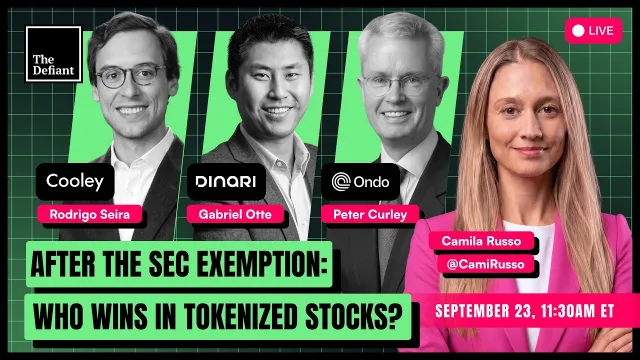
Original title: 🟢 LIVE : Synthetic vs. Direct Tokenized Stocks: Who Wins After The SEC Exemption?

The Defiant 1:06:31 955 views on YouTube ONDO −4.4%
Thumbnail for 🟢 LIVE : Synthetic vs. Direct Tokenized Stocks: Who Wins After The SEC Exemption? 1:06:31

Watch on YouTube Opens on youtube.com in a new tab. Playback here uses youtube-nocookie.com.

Summary

The SEC has issued an exemption for tokenized equities. This has reopened a question for issuers. Should a tokenized stock be a synthetic instrument that tracks the price? Or should it be a direct claim on the underlying share? Issuers have been working around this question. The models handle custody, investor rights, compliance, and access for non-U.S. users differently. Rodrigo Seira, a partner at Cooley, breaks down what the exemption allows and where legal lines still sit. Gabriel Otte, co-founder of Dinari, and Peter Curley, head of global regulatory affairs at Ondo Finance, lay out how each model works. They also discuss which structure is better placed to scale now that the rules have changed. The discussion covers the legal and practical differences between synthetic and direct tokenized stocks. It also looks at how each approach treats investors and regulatory requirements. The question is which model wins after the SEC exemption.

This AI summary uses the title, description and tags. It may miss context from the full video. How summaries are checked

Key points

  1. The SEC has issued an exemption for tokenized equities.
  2. Tokenized stocks can be structured as synthetic instruments that track the price or as direct claims on the underlying share.
  3. Each model handles custody, investor rights, compliance, and access for non-U.S. users differently.
  4. Rodrigo Seira, partner at Cooley, explains what the exemption allows and where legal lines still sit.
  5. Gabriel Otte, co-founder of Dinari, and Peter Curley, head of global regulatory affairs at Ondo Finance, compare how each model works and which structure is better placed to scale now that the rules have changed.
  6. The discussion covers legal and practical differences between synthetic and direct tokenized stocks, including how each treats investors and regulatory requirements.

Questions

What is the difference between synthetic and direct tokenized stocks?
A synthetic tokenized stock tracks the price of the underlying share, while a direct tokenized stock is a claim on the underlying share.
What issues do the models handle differently?
They handle custody, investor rights, compliance, and access for non-U.S. users differently.

A video appearing here is not an endorsement. Crypto assets can lose value. This page provides information, not investment advice.